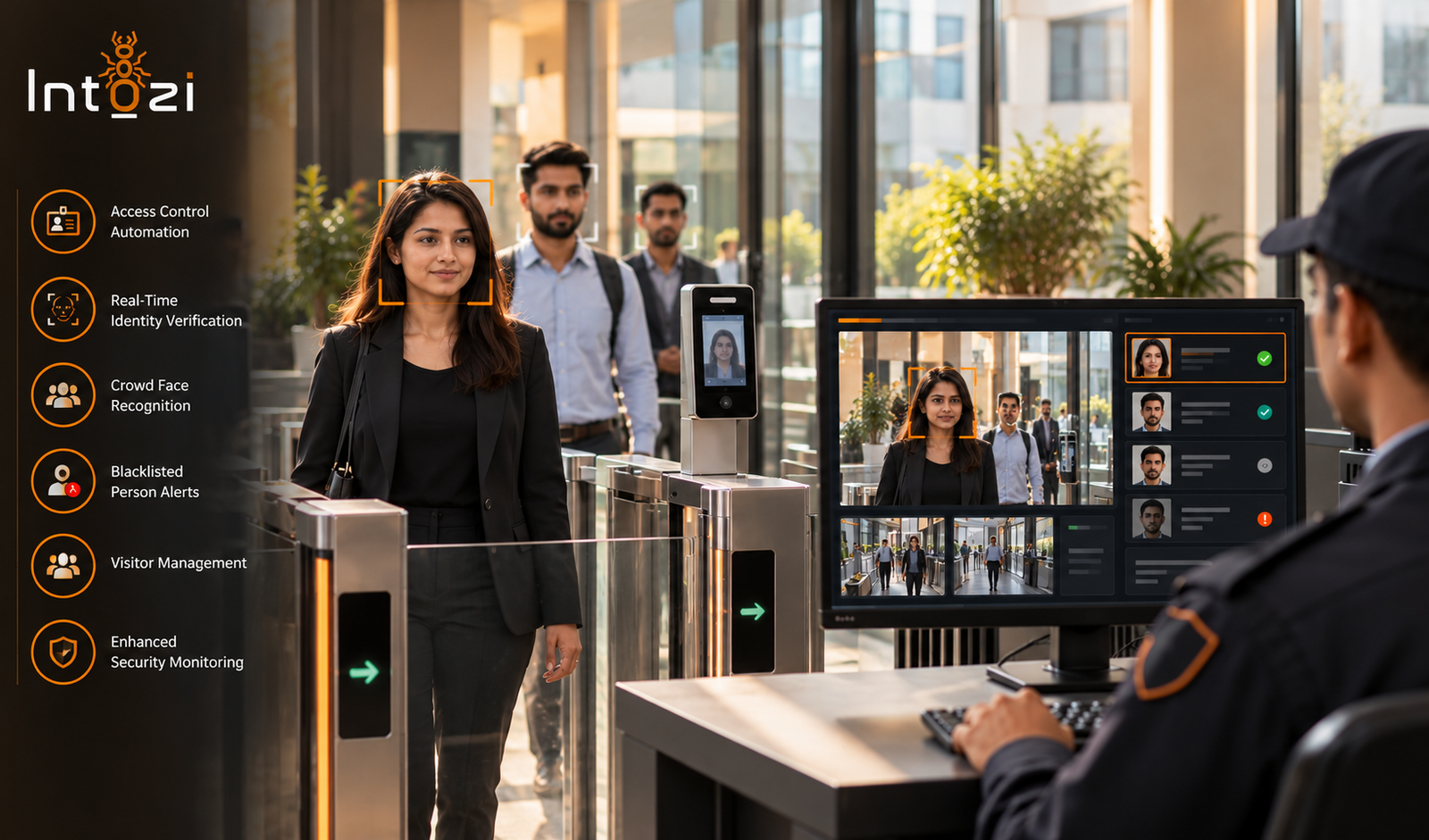


Managing security in busy public spaces, commercial buildings, and workplaces can be challenging when manual identity checks and traditional surveillance systems cannot keep up with activity. AI identity verification helps organizations streamline identity checks, improve access management, and support more efficient security operations through AI-powered technologies.
How AI Supports Identity Verification
AI identity verification uses artificial intelligence to support the process of confirming whether a person matches an expected identity. Depending on the system, this may involve facial recognition, document verification, or other authentication methods. In physical security environments, facial recognition can help compare a person’s facial features with previously enrolled records, subject to system accuracy and appropriate privacy safeguards.
Improving Access Management With Face Recognition
Businesses often need to control entry to offices, industrial facilities, data centres, and restricted areas. Face recognition for access control can support identity checks at designated entry points and help security teams manage authorized access. When integrated with access management systems, it can complement badges, PINs, and other authentication methods rather than relying on facial matching alone.
The Role of Face Recognition in Crowded Environments
Busy transport hubs, commercial spaces, and large venues can present challenges for security personnel who must monitor many people simultaneously. Crowd face recognition refers to using facial recognition technology in environments where multiple people may appear in the camera feed. Its effectiveness depends on factors such as face visibility, camera placement, crowd density, lighting, and image resolution.
Understanding Face Recognition in a Crowd
Face recognition in crowd environments is more complex than recognizing a single person in a clear image. Faces may be partially blocked, viewed from different angles, or captured at a distance. These conditions can affect matching accuracy, making it important to evaluate the technology under real operating conditions and include human review when a result is uncertain.
Face Detection for Crowd Monitoring
Crowd face detection is different from facial recognition. Face detection identifies the presence and location of faces in an image or video, while facial recognition attempts to match a detected face to an identity or enrolled facial template. Crowd face detection can support crowd monitoring and video analysis, but detecting a face does not establish who the person is.
Integrating AI With Modern Surveillance Systems
Organizations can use AI-powered video analytics to extend the capabilities of compatible CCTV and IP camera infrastructure. Depending on the solution, video analytics platforms can help centralize detections, alerts, and event records for security teams. Intozi’s Ikshana platform supports AI-powered video analytics for operational monitoring and security use cases; specific facial recognition capabilities depend on the deployed configuration.
Conclusion
Face recognition and face detection can contribute to modern security operations when applied to appropriate use cases. From AI identity verification and face recognition for access control to crowd face recognition and crowd face detection, each capability serves a different purpose. Intozi provides AI-powered video analytics solutions through its Ikshana platform, helping organizations improve security monitoring and operational visibility using compatible camera infrastructure. Businesses should assess accuracy, privacy requirements, data protection, and human oversight before deploying these technologies, particularly in public or crowded environments.
Frequently Asked Questions (FAQs)
1. What is face recognition technology and how does it work?
Face recognition technology uses artificial intelligence to analyze facial features and compare them with stored facial data to verify or identify a person. Intozi works in the AI video analytics domain, helping organizations enhance security monitoring through intelligent video analysis. The effectiveness of facial recognition depends on image quality, lighting, camera angles, and the system’s configuration.
2. How is face recognition used in modern security systems?
Face recognition can support identity verification, controlled entry, and security investigations in offices, commercial buildings, and industrial facilities. Intozi provides AI-powered video analytics through its Ikshana platform, helping organizations improve visibility across compatible camera infrastructure. The specific capabilities available depend on the deployment and integration requirements.
3. Can face recognition software work with existing CCTV cameras?
Yes, face recognition software may work with existing CCTV or IP cameras if their resolution, positioning, video quality, and system compatibility meet the requirements. Intozi’s Ikshana platform helps organizations extend compatible camera infrastructure with AI-powered video analytics, reducing the need for complete infrastructure replacement in suitable deployments.
4. What is the difference between face detection and face recognition?
Face detection identifies the presence and location of a face in an image or video, whereas face recognition compares facial features against stored facial data to find a possible identity match. Intozi focuses on AI-powered video analytics that can support security and operational monitoring. The distinction matters because detecting a face does not establish a person’s identity.
5. How does face recognition help with access control?
Face recognition can support access control by comparing a person’s face with an enrolled identity before an access decision is made. Intozi’s video analytics expertise can help organizations strengthen their broader security monitoring workflows, while any face-based access decision requires compatible integrations, appropriate authorization, and safeguards against incorrect matches.