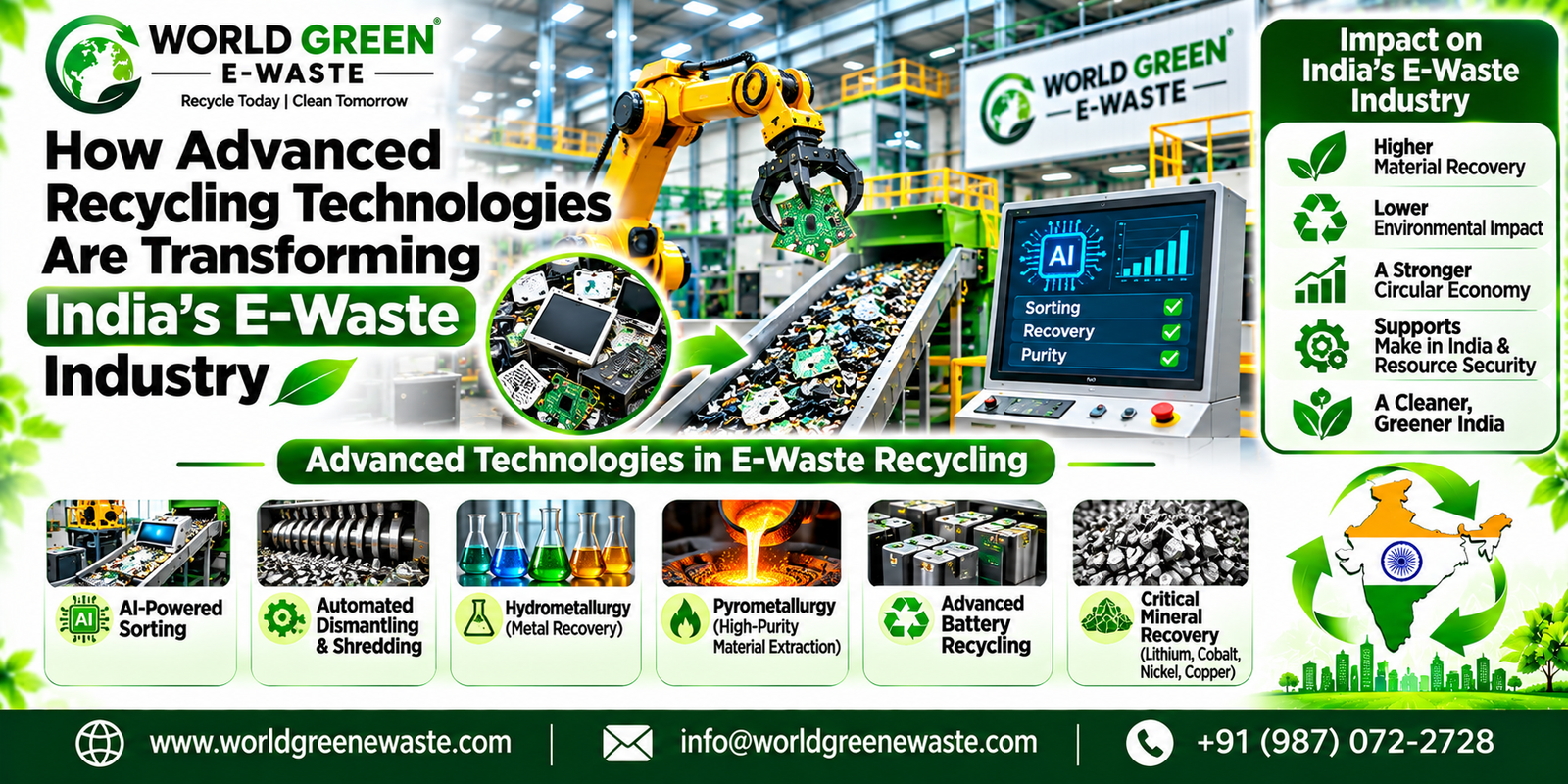


A few weeks ago, I was chatting with a friend who works in the recycling business. I asked what had changed the most in recent years. He smiled and said, “The way we handle a single circuit board today would have seemed impossible not long ago.” That stayed with me. E-waste recycling in India is slowly moving from rough and manual to smarter and safer, and the change matters to all of us.
Where We Started
For a long time, a lot of e-waste in India was handled informally. Wires were burned to get copper, and circuit boards were soaked in acid to pull out metals. It was quick and cheap, but it harmed workers, polluted the air and water, and wasted valuable materials. Better technology offers a way out of that picture.
The Technologies Making a Difference
Here are some of the key improvements you’ll hear about:
- Automated sorting: Cameras, sensors and software help identify and separate different types of devices, plastics and metals faster and more accurately.
- Robotic and mechanical dismantling: Machines can help take apart devices, so workers face fewer hazards.
- Advanced shredding and separation: Magnets, air flow and other techniques sort metals, plastics and glass into clean streams.
- Safer battery handling: Careful discharging and controlled dismantling reduce the fire risk from lithium batteries.
- Modern metal recovery: Methods using liquid solutions or high heat help extract metals like copper, gold, silver and palladium from circuit boards, and lithium, nickel and cobalt from battery material such as black mass.
- Digital tracking: Software helps record what comes in, what’s processed and what’s recovered, which supports proper documentation.
Think of it as upgrading from a hand tool to a well-designed workshop.
What’s Actually Getting Better
- Safer workplaces: Machines handle the most dangerous jobs, which means less exposure to toxic fumes and sharp or heavy items.
- Cleaner environment: Controlled processes reduce open burning, acid baths and harmful dumping.
- More material recovered: Better separation means more metals and plastics go back into use instead of being wasted.
- Better data protection: Organised systems make it easier to wipe or destroy storage devices and keep records.
- Support for national goals: Recovering materials at home can help India depend less on imports of critical minerals.
The Challenges Still There
I don’t want to oversell this. Technology doesn’t fix everything.
- Cost: Advanced equipment needs investment, and not every recycler can afford it.
- Skills: Machines still need trained people to run and maintain them.
- Different designs: Devices come in all shapes, which makes automation tricky.
- Collection: A large share of e-waste still travels through informal channels, so much of it never reaches modern facilities.
A clever machine can’t help if the e-waste never arrives.
Why This Matters to You
You might wonder what any of this has to do with your old laptop. Quite a lot, actually. When you choose an authorised recycler, your devices are more likely to reach facilities that use safe, modern methods. India’s E-Waste (Management) Rules, 2022 also encourage proper collection and recycling through authorised channels.
How You Can Help
- Back up and wipe your data before handing anything over.
- Gather everything, including chargers, cables and batteries.
- Choose a recycler approved by the Central Pollution Control Board (CPCB) or your State Pollution Control Board.
- Ask how your devices and data will be handled, and get a receipt and recycling certificate.
- Avoid scrap dealers who offer quick cash but have no safe process.
If you’d like a simple and responsible way to recycle, you can reach out to us at World Green E-Waste and we’ll guide you through it.
Final Thoughts
Advanced recycling technologies are helping India’s e-waste industry become safer, cleaner and more efficient. But technology is only half the story. The other half is people choosing to recycle the right way. So the next time you find a dead device in a drawer, remember that a better journey is waiting for it, as long as it goes to the right place.
I kept the article general and didn’t name specific machines, companies or statistics, since I can’t verify them. If you have details about your own facility’s technology, send them over and I’ll make the article more specific. I can also prepare the metadata, meta tags, tags and a social bookmarking description, as before.
Read another Article: From Corporate E-Waste to Sustainable Impact