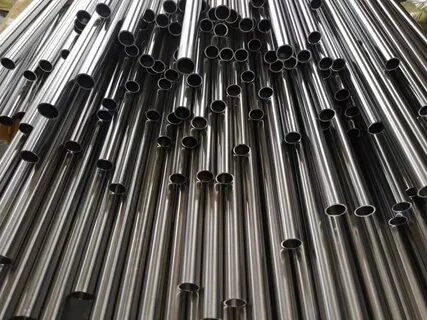


Stainless Steel Capillary Tubing moves fluid and pressure through bores measured in tenths of a millimetre, where conventional tubing cannot fit or hold tolerance. Scale changes the engineering. A 0.1 mm wall leaves no margin for ovality or drawing defects, so mills hold tighter dimensional control here than on any other tube product. Hospitals, refineries, laboratories and engine bays all need the same outcome: a small measured volume delivered without leakage.
What Is Stainless Steel Capillary Tubing?
A SS Capillary Tube is a thin-walled stainless tube whose internal bore governs performance. These tubes produce 0.35 mm to 6.35 mm OD with walls from 0.1 mm to 1.2 mm, extending to 12.0 mm OD in SCH 5/5S, 10/10S and 20/20S. Standard tube carries volume between two points. Capillary tubing meters it, restricts it or senses it, which loads the entire duty onto bore accuracy. Drift of 0.02 mm on a 0.5 mm bore shifts flow area by roughly 8%, enough to corrupt a calibrated instrument reading.
Key Benefits of Stainless Steel Capillary Tubing
Six properties explain why engineers specify stainless at this diameter.
- Corrosion resistance: Grades 304 and 316 resist moisture, steam and mild acids, extending service life across washdown and outdoor installations.
- Dimensional consistency: Tight OD and wall tolerances keep bore volume repeatable, so metered doses and pressure readings match between batches.
- Strength at small sizes: Cold-drawn stainless sustains working pressure at 0.1 mm walls where polymer or copper tubing creeps and ruptures.
- Chemical resistance: Grade 316 carries 2% to 3% molybdenum, which handles chlorides and saline media far better than 304.
- Compact routing: A 0.35 mm tube threads into sensor housings, catheter shafts and analyser manifolds that standard tube cannot enter.
- Cleanability: Smooth drawn bores resist particle hold-up, so a short flush clears residue in laboratory and pharmaceutical fluid lines.
Types of Stainless Steel Capillary Tubes
Construction, grade and dimensions define the four choices buyers face.
- Seamless Capillary Tubes: Drawn from solid billet with no weld line, giving uniform wall structure for pressure and vacuum duty.
- Welded Capillary Tubes: Rolled from strip, welded and then drawn down, which suits low-pressure transfer lines at reduced cost.
- Different Stainless Steel Grades: Grade 304 covers general service, while 316 handles chlorides, sterilisation cycles and aggressive laboratory chemistry.
- Different Sizes and Wall Thicknesses: Bore sets flow rate and wall sets pressure rating, so specify both figures together.
Stainless Steel Capillary Seamless Tube: Features and Advantages
Removing the weld seam is critical for most applications.
- Seamless manufacturing process: Cold drawing over a mandrel reduces OD and wall in stages, refining grain structure through the full section.
- Uniform construction: No weld bead means no internal step, so flow stays undisturbed and wall strength remains equal around the circumference.
- Pressure-sensitive duty: A Stainless Steel Capillary Seamless Tube suits hydraulic sensing lines where a seam becomes the first failure point.
- Verification before release: Confirm grade, tolerance band and non-destructive test requirements against ASTM A213 before approving any production batch.
Industrial Applications of SS Capillary Tube
Six sectors depend on small-bore stainless tubing.
- Medical and Healthcare Equipment
Surgical instruments, catheter shafts and dosing lines use 316 tubing that withstands repeated autoclave sterilisation.
- Instrumentation and Measurement
Pressure transmitters and gauge siphons use capillary bores to damp pulsation and isolate hot process fluid.
- Automotive Industry
Fuel rail sensors, EGR pressure lines and brake wear circuits route capillary tubing through congested engine bays.
- Chemical and Laboratory Equipment
HPLC columns, chromatography injectors and titration rigs transfer microlitre volumes without carryover between samples.
- Aerospace and Industrial Equipment
Hydraulic sensing lines and fuel system instrumentation survive sustained vibration while adding minimal mass.
- Research and Testing Equipment
Mass spectrometers, gas sampling benches and calibration rigs depend on repeatable bore volume for valid data.
Stainless Steel Capillary Tubing vs. Standard Stainless Steel Tubes
Both products share the same alloys and corrosion behaviour. Purpose splits them. One measures and controls, the other transports volume, and that gap drives every difference below.
| Factor | Capillary Tubing | Standard Tubes |
| Diameter and wall | 0.35 mm to 6.35 mm OD, 0.1 mm to 1.2 mm wall | 6 mm and up, walls above 0.5 mm |
| Tolerance | Micron-level bands on bore | Commercial tolerances tied to schedule |
| Flow capacity | Microlitre to millilitre per minute | Litres per minute and above |
| Manufacturing | Multi-pass cold drawing, intermediate annealing | Single-pass forming, welded or seamless |
| Cost basis | Per metre, on tolerance and finish | Per kilogram, on weight and grade |
| Selection driver | Measurement accuracy, response time | Throughput, pressure class, installed cost |
How to Choose the Right Stainless Steel Capillary Tubing
Seven specifications decide whether a tube performs or fails in service.
- Outside and inside diameter: Fix the bore first because it governs flow and response time, then select OD around it.
- Wall thickness and tolerances: Thicker walls raise burst pressure but shrink bore, so balance both against your actual duty cycle.
- Grade and chemical compatibility: Match 304 or 316 to the media, service temperature and chloride content the line genuinely sees.
- Operating pressure and temperature: Derate the published rating at elevated temperature using allowable stress values in ASTM A213.
- Length, finish and surface quality: Specify coil or straight lengths, plus bright annealed or polished bore where cleanliness drives performance.
- Seamless or welded construction: Select seamless for pressure, vacuum and analytical work, welded for low-pressure transfer at lower cost.
- Certification and supplier reliability: Request mill test certificates, hydrostatic or eddy current reports and third-party inspection before accepting dispatch.
Conclusion
Small-bore stainless earns its place wherever accuracy outranks throughput. Corrosion resistance, repeatable bore volume and strength at a 0.1 mm wall let one component serve a catheter, a transmitter and a spectrometer inlet. Grade, dimensions and construction carry equal weight: a 304 tube in a chloride line fails as surely as an oversized bore ruins a calibration. Ask for the mill test certificate, the tolerance band and the test report before the purchase order goes out.