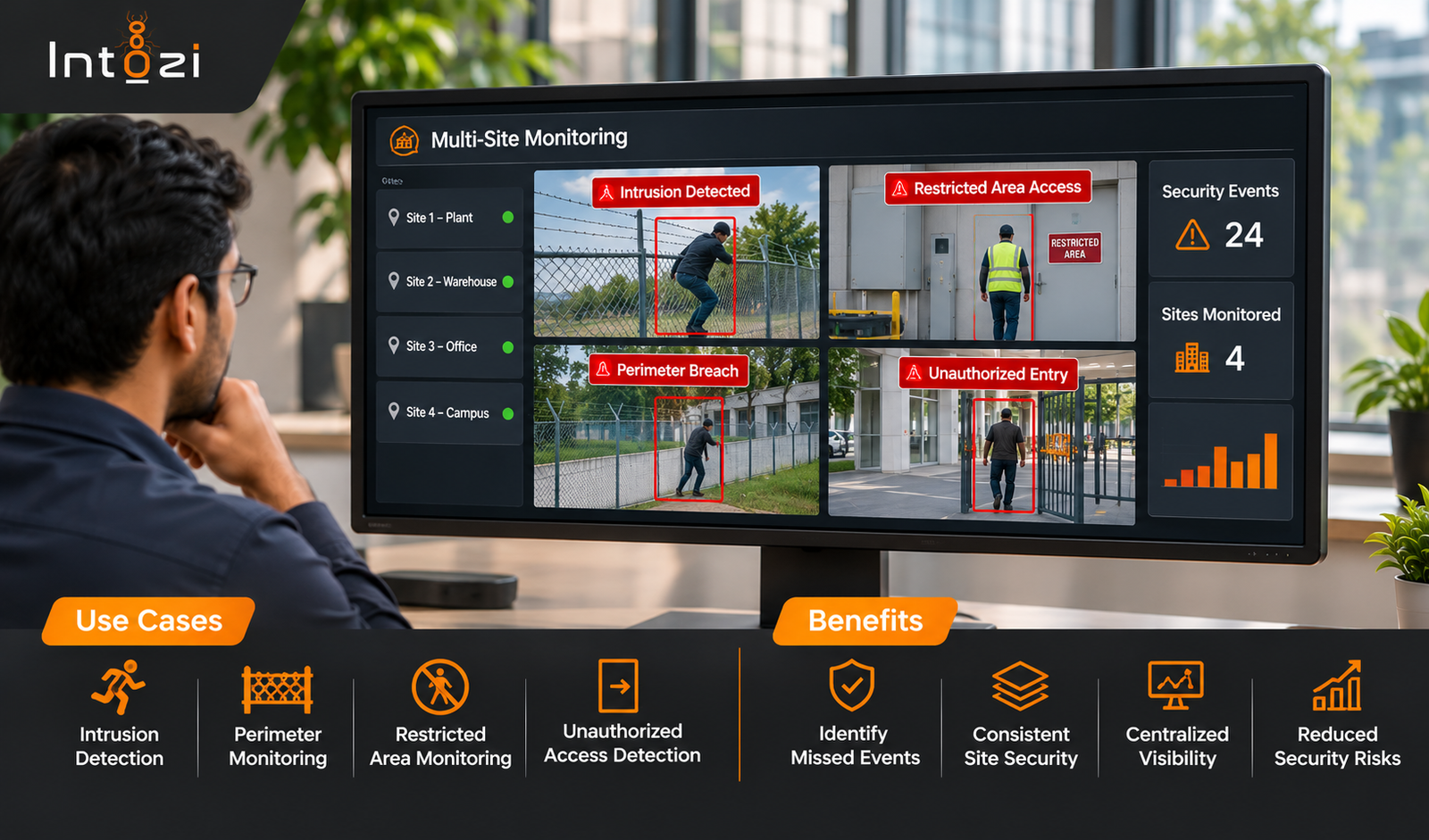


Large enterprises often operate across multiple buildings, warehouses, manufacturing units and restricted operational areas. Monitoring security activities across these locations can become difficult when security teams depend heavily on manual video reviews and separate surveillance systems. Important incidents, such as unauthorized entry, perimeter breaches or movement in restricted areas, may go unnoticed when monitoring resources are limited.
An AI video surveillance software approach helps address these challenges by analysing video feeds to identify predefined security events and activities that require attention. Instead of relying entirely on personnel to observe every camera, enterprises can use computer vision to support more structured security monitoring.
Why Enterprises Miss Important Security Events Across Multiple Sites
Security monitoring becomes increasingly complex as organisations expand their physical infrastructure. A facility may have multiple entry points, loading areas, server rooms, production zones and outdoor boundaries that require different levels of protection.
Manual monitoring presents several limitations:
- High monitoring workload: Security personnel may need to observe multiple video feeds simultaneously.
- Missed incidents: Brief or less visible security events can be overlooked.
- Inconsistent monitoring: Different facilities may follow different monitoring practices.
- Delayed identification: Security teams may identify an incident only after reviewing recorded footage.
- Limited visibility: Central security teams may find it difficult to assess activities across geographically distributed locations.
An intelligent surveillance system can help address these gaps by identifying configured security events and making relevant video information easier to review.
How AI Video Analytics Helps Identify Security Events
An AI surveillance system uses computer vision models to analyse video footage and identify objects, movements and activities based on configured detection requirements. These models can be applied to specific security scenarios across enterprise facilities.
For example, video analytics can support:
- Intrusion detection: Identifying people entering designated restricted areas.
- Perimeter monitoring: Detecting unauthorised movement near protected boundaries.
- Tailgating detection: Identifying instances where an unauthorised person follows an authorised individual through an access point.
- Unattended object detection: Identifying objects left in designated monitored areas.
- Restricted-area monitoring: Detecting people entering operational zones where access is limited.
These capabilities help security teams focus their attention on specific events instead of depending entirely on continuous manual observation. Detection results should still be reviewed in context, as environmental conditions, camera angles and visual obstructions can influence accuracy.
Key Requirements for Enterprise Security Surveillance
Selecting suitable enterprise surveillance software requires more than evaluating its ability to detect individual objects. Organisations should consider how the technology fits into their existing security infrastructure and operational procedures.
Important requirements include:
- Multi-location coverage: Supporting monitoring requirements across different buildings and facilities.
- Configurable detection: Allowing security teams to define analytics based on site-specific risks.
- Event documentation: Maintaining relevant detection records and associated video evidence.
- Deployment flexibility: Supporting suitable edge, on-premise, air-gapped or cloud environments.
- Integration capabilities: Working with existing video infrastructure and relevant security systems.
These requirements help enterprises establish a consistent approach to security monitoring while accommodating the operational differences between facilities.
How AI Security Surveillance Supports Enterprise Operations
AI security surveillance can contribute to several areas of enterprise security beyond basic intrusion detection. Manufacturing facilities may require monitoring of restricted production areas, while warehouses may need visibility into loading zones and storage areas. Data centres may require additional monitoring around server rooms and sensitive infrastructure.
Computer vision can support these requirements through configured detection use cases such as:
- Monitoring restricted operational areas.
- Identifying unauthorised entry at designated access points.
- Detecting suspicious movement near protected boundaries.
- Monitoring access to sensitive infrastructure.
- Reviewing security events across multiple facility locations.
The exact applications depend on the organisation’s security policies, camera coverage and detection requirements.
Intozi and Ikshana for AI-Powered Video Analytics
Intozi develops computer vision and video analytics solutions for enterprise and industrial environments. Its platform, Ikshana, supports security-related applications such as intrusion detection, perimeter monitoring, restricted-area monitoring and tailgating detection.
Ikshana can work with compatible existing video infrastructure and supports edge, on-premise, air-gapped and cloud deployment environments. Its no-code analytics configuration allows organisations to configure relevant detection use cases according to their operational requirements.
For enterprises managing multiple facilities, these capabilities can support a more structured approach to identifying and reviewing security events. Implementation should account for site-specific conditions, camera placement, integration requirements and established security procedures.
Conclusion
Missed security events can create operational and security challenges for enterprises managing multiple facilities. AI video analytics helps address monitoring limitations by identifying configured activities such as intrusion, unauthorised access and restricted-area entry. An AI video surveillance software approach, supported by an intelligent surveillance system, can improve the consistency of security event identification. Solutions such as Intozi‘s Ikshana provide configurable video analytics capabilities that organizations can assess as part of their wider enterprise security infrastructure.
Frequently Asked Questions
1. How does AI video surveillance software help enterprises improve security?
AI video surveillance software analyses video footage to identify configured security events, including intrusion, unauthorised entry and restricted-area movement. It helps security teams locate relevant incidents without depending entirely on continuous manual observation. Intozi’s Ikshana platform supports these video analytics applications, allowing enterprises to configure detection requirements according to their facility layouts and security procedures.
2. What is the difference between an AI surveillance system and traditional video surveillance?
Traditional video surveillance primarily records footage for observation and later review. An AI surveillance system adds computer vision capabilities to identify specific objects, movements and activities within video footage. This can help highlight potential security events for further review. Ikshana from Intozi supports AI-powered detection use cases such as intrusion, perimeter and restricted-area monitoring.
3. Can an intelligent surveillance system monitor multiple enterprise locations?
Yes, an intelligent surveillance system can support security monitoring requirements across multiple facilities, depending on its architecture, connectivity and deployment configuration. Organisations can define relevant detection requirements for different locations and operational zones. Intozi’s Ikshana platform offers flexible deployment options, including edge, on-premise, air-gapped and cloud environments, subject to infrastructure requirements.
4. Which security events can AI security surveillance detect?
AI security surveillance can be configured to identify events such as intrusion, perimeter breaches, unauthorised movement, tailgating and entry into restricted areas. The available detection capabilities depend on the analytics models, camera coverage and site conditions. Ikshana supports several of these security-focused video analytics applications for industrial and enterprise environments.
5. What should enterprises consider when choosing enterprise surveillance software?
Enterprises should evaluate detection capabilities, compatibility with existing video infrastructure, deployment flexibility, integration requirements, event documentation and support for multiple locations. Detection performance should also be assessed under actual operating conditions. Intozi’s Ikshana platform provides configurable video analytics and multiple deployment options that organisations can evaluate against their enterprise security requirements.