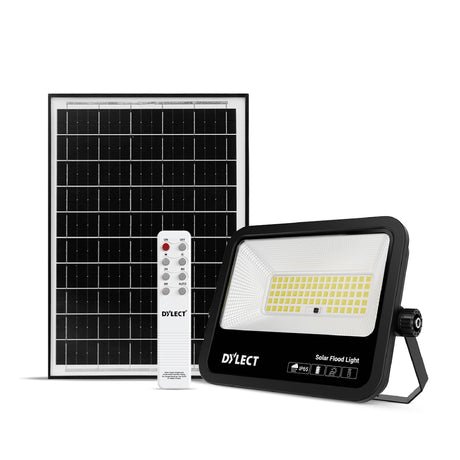


Outdoor lighting is useful for entrances, pathways, gardens, boundary walls, driveways, and other areas around a property. However, keeping outdoor lighting at full brightness throughout the night is not always necessary. This is where motion-sensing technology can make a difference. Motion sensor solar lights combine solar-powered operation with automatic movement detection, allowing illumination to respond to activity rather than remaining continuously bright.
How Do Motion Sensor Solar Lights Work?
During the daytime, a solar panel collects sunlight and converts it into electrical energy, which is stored in a rechargeable battery. After dark, the stored energy powers the light.
The motion sensor adds another layer of control. Depending on the lighting mode, the fixture can remain off or operate at lower brightness when no movement is detected. When someone approaches, the sensor activates brighter illumination for a certain period.
This responsive operation makes solar lights particularly practical for spaces where strong illumination is only needed occasionally.
Why Motion Detection Can Help Save Stored Energy
The battery capacity of a solar-powered fixture is limited to the energy collected and stored during charging. Therefore, how that stored power is used throughout the night matters.
A light running continuously at maximum brightness consumes stored energy steadily. Motion-controlled operation can reduce unnecessary high-brightness usage by activating stronger illumination primarily when movement occurs.
This makes motion-sensing solar lights useful for entrances, gates, driveways, side passages, boundary walls, and similar spaces where people or vehicles may only pass occasionally.
Multiple Lighting Modes Improve Flexibility
One advantage of modern motion-sensitive outdoor lighting is the availability of different operating modes. Some products offer several motion or brightness settings, allowing users to choose how the light responds after dark.
For example, one mode may keep the fixture off until motion is detected, while another may maintain lower illumination before switching to brighter output when someone approaches. The exact functions depend on the individual model.
This flexibility allows homeowners to balance visibility and battery usage according to the location. A frequently used entrance may benefit from some continuous illumination, while a less frequently used side area may only require light when movement occurs.
Useful for Security-Oriented Outdoor Areas
Motion activation can also make outdoor illumination more purposeful. Instead of keeping an area continuously bright, the light responds when activity is detected.
For locations such as entrances, walls, driveways, garages, or gates, sudden illumination can improve visibility when someone approaches. Users can see steps, obstacles, pathways, doors, or surrounding areas more clearly without manually switching on a fixture.
The availability of wall, security, garden, pathway, flood, and other outdoor solar lights also makes it possible to choose lighting according to the space and intended application.
Solar Charging Reduces Dependence on Grid Electricity
Another important part of energy-saving outdoor illumination is the power source itself. Solar-powered fixtures collect renewable energy during daylight hours and use the stored power after dark.
As a result, they can reduce dependence on grid electricity for suitable outdoor applications. They can also be useful in locations where extending electrical wiring would be inconvenient.
When motion sensing is combined with solar charging, energy management becomes even more targeted. The system gathers energy during the day and then manages its use based on nighttime activity.
Placement Matters for Better Performance
Even an efficient lighting system needs proper placement. The solar panel should receive sufficient sunlight during the day so the battery can charge effectively. Locations heavily shaded by walls, roofs, trees, or other structures may reduce charging performance.
The motion sensor should also face the area where movement is most likely to occur. For example, a wall-mounted fixture near a gate should be positioned so approaching people or vehicles enter its detection area.
Correct positioning helps solar lights make better use of both available sunlight and motion detection.
Where Are Motion Sensor Models Most Useful?
Motion-controlled lighting works particularly well in areas that do not need maximum brightness continuously. Residential entrances, driveways, garden boundaries, exterior walls, pathways, garages, and side passages are good examples.
They can also be useful in outdoor spaces where lighting needs vary throughout the night. Instead of treating every location the same, homeowners can use continuously illuminated fixtures where required and motion-activated options in lower-traffic areas.
This creates a more practical lighting setup while making efficient use of stored solar energy.
Are They Better for Energy Saving?
For locations where full brightness is only needed when someone is present, motion sensor solar lights can offer a more energy-conscious approach than keeping a fixture at maximum output throughout the night. Their effectiveness depends on factors such as available sunlight, battery capacity, brightness settings, motion modes, installation position, and frequency of activation.
The main advantage is intelligent energy use. Rather than providing maximum illumination whether it is needed or not, motion detection allows solar lights to respond to activity. When combined with proper installation and suitable lighting modes, this approach can provide convenient outdoor visibility while making more efficient use of the energy collected during the day.