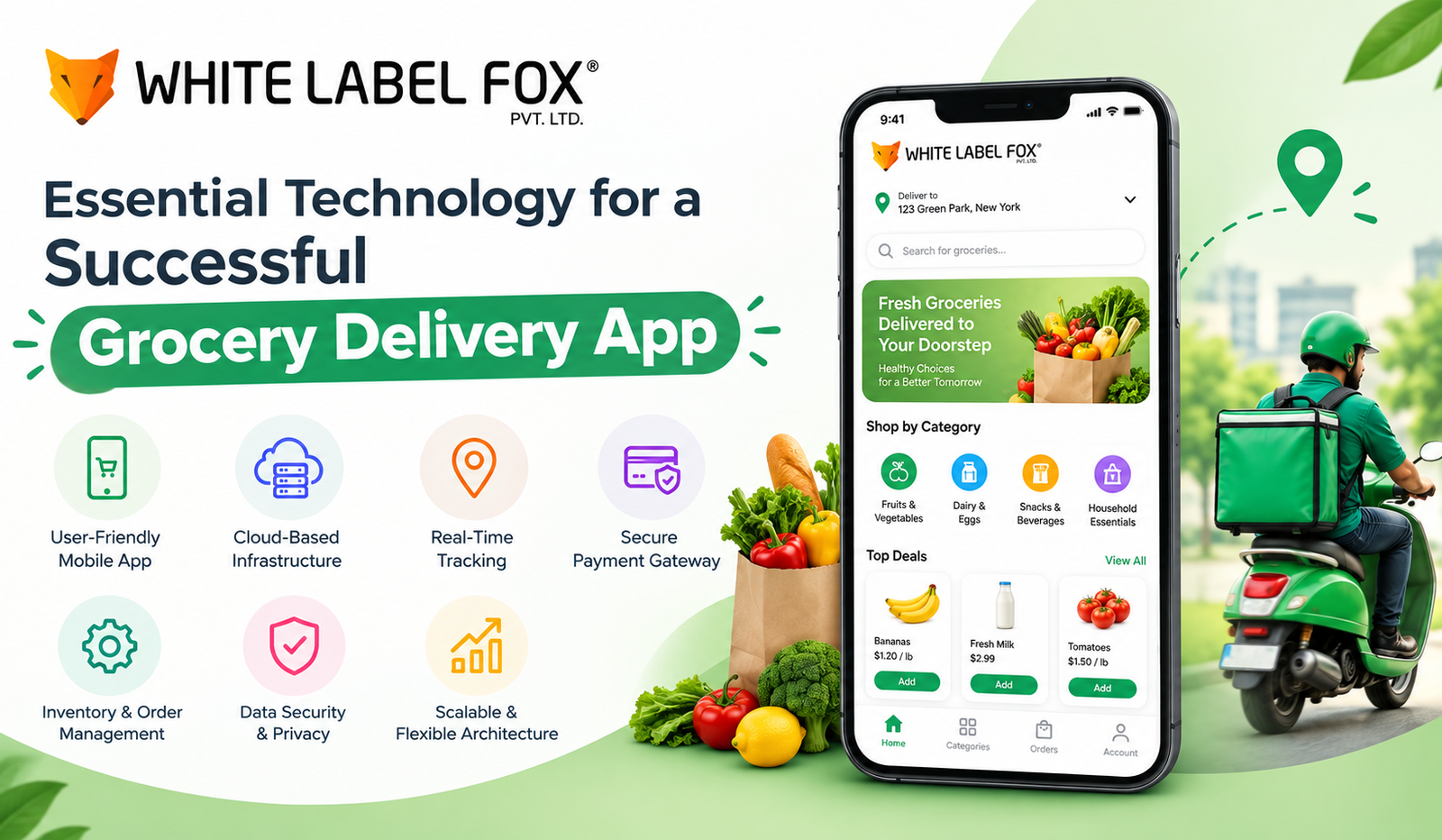


The grocery industry is rapidly moving toward digital ordering, doorstep delivery, and on-demand convenience. Customers now expect to browse products, compare options, place orders, track deliveries, and receive timely updates through a single mobile experience. For businesses, this shift creates an opportunity to build a scalable digital grocery marketplace and serve customers across multiple locations.
However, launching a successful platform requires more than simply listing grocery products in an app. The right technology can improve customer convenience, simplify order management, support delivery operations, and help businesses make better decisions using real-time data.
For startups and entrepreneurs planning Grocery Delivery App, understanding the essential technologies behind a modern grocery platform can help create a reliable and competitive solution.
Why Technology Matters in a Grocery Delivery App
A grocery delivery platform needs to coordinate several activities at the same time. Customers need an easy way to discover products, while stores or vendors need tools to manage their catalogs and orders. Delivery partners also need accurate information to complete deliveries efficiently.
Technology connects these different operations into one ecosystem.
A modern grocery platform should support:
- Easy product discovery and search
- Real-time order status
- Accurate location tracking
- Secure digital payments
- Delivery partner coordination
- Personalized product recommendations
- Automated notifications
- Multiple store or vendor management
- Business analytics and reporting
Choosing suitable technologies during Grocery Delivery App Development can make the platform more flexible and prepared for future expansion.
Essential Technologies for a Grocery Delivery Platform
Several technologies contribute to the performance and usability of a modern grocery delivery platform. Each one addresses a specific business or customer requirement.
1. Artificial Intelligence and Machine Learning
Artificial intelligence can make a grocery platform more personalized and efficient. Instead of showing the same products to every customer, AI can analyze customer activity and identify relevant products or purchasing patterns.
Businesses can use AI for:
- Personalized product recommendations
- Smart search suggestions
- Frequently purchased item predictions
- Demand forecasting
- Automated customer support
- Product discovery
- Order pattern analysis
For example, if a customer regularly purchases milk, vegetables, or household products, the platform can recommend those items at relevant times.
AI can also help businesses identify demand trends and improve inventory planning. This makes artificial intelligence an important consideration for businesses investing in Grocery Delivery App Development.
2. GPS and Real-Time Location Tracking
Location technology is essential for on-demand grocery delivery. Customers want to know where their orders are and when they are likely to arrive.
GPS technology allows businesses to provide:
- Live delivery tracking
- Accurate delivery locations
- Driver route monitoring
- Estimated arrival information
- Nearby store discovery
- Delivery zone management
Real-time tracking can also improve communication between customers, stores, and delivery partners. Businesses can monitor active deliveries and identify potential delays more quickly.
3. Cloud Technology
A grocery platform may experience different levels of demand throughout the day. Traffic can increase during weekends, holidays, promotional campaigns, or special events.
Cloud technology can help businesses handle changing workloads and support continuous platform availability. It also provides flexibility when a business expands into new cities or adds more stores and delivery partners.
For startups, this scalability is particularly useful because the platform can evolve alongside business growth instead of being restricted to a small operational area.
4. Secure Payment Technology
Customers expect fast and convenient payment experiences when ordering groceries online. A grocery delivery platform should support trusted digital payment methods while keeping transactions secure.
Depending on the target market, businesses can consider options such as:
- Credit and debit cards
- Digital wallets
- Online banking
- Local payment methods
- Cash on delivery
- Promotional credits
Secure payment technology helps reduce friction during checkout and gives customers greater flexibility when completing purchases.
5. Application Programming Interfaces
APIs allow different digital services to communicate with the grocery platform. They can connect essential services such as maps, payments, notifications, analytics, and communication tools.
For example, map APIs can support location-based services, while payment APIs can enable online transactions.
During Grocery Delivery App Development, carefully selected APIs can help businesses add useful capabilities without creating every supporting service from scratch.
The important consideration is to select reliable integrations that match the business model, target geography, and expected scale.
6. Push Notifications and Real-Time Communication
Communication is an important part of the grocery ordering experience. Customers should receive timely updates when their order is confirmed, prepared, dispatched, or delivered.
Push notification technology can be used for:
- Order confirmation
- Delivery updates
- Promotional offers
- Payment notifications
- Delivery partner alerts
- Order completion messages
Real-time communication can also help customers communicate with delivery partners when necessary. Clear updates reduce uncertainty and create a smoother ordering experience.
7. Data Analytics
Data can help grocery businesses understand how customers interact with their platform. Analytics technology can identify purchasing patterns, popular products, high-demand locations, order frequency, and customer engagement.
Businesses can use these insights to make informed decisions about:
- Product selection
- Promotions
- Delivery operations
- Customer retention
- Expansion opportunities
- Marketing campaigns
Instead of relying entirely on assumptions, entrepreneurs can use platform data to understand what customers actually need.
8. Recommendation Engines
A recommendation engine can help customers discover relevant products without manually searching through large catalogs.
For example, when a customer adds pasta to the cart, the platform may recommend sauces, cheese, or other related products. These recommendations can improve product discovery while creating opportunities for businesses to increase order value.
Recommendation technology becomes particularly useful as the product catalog grows and customers have more choices.
9. Advanced Search and Product Discovery
Grocery platforms often contain thousands of products across different categories and brands. A powerful search experience allows customers to find products quickly.
Modern search technology can support:
- Keyword-based searches
- Category filters
- Brand filters
- Product suggestions
- Voice-based searches
- Spelling corrections
- Relevant search results
A simple and responsive discovery process can reduce the time customers spend searching and make the overall shopping journey more convenient.
10. Technology for Delivery Optimization
Delivery operations directly affect customer satisfaction. Long delivery times, inefficient routes, and poor coordination can create operational challenges.
Route optimization technology can help identify efficient routes based on delivery locations and current conditions. Businesses can also use intelligent delivery assignment to connect orders with suitable delivery partners.
This becomes increasingly important when a business expands its delivery network and handles a larger number of simultaneous orders.
How These Technologies Create a Competitive Advantage
Technology should not be added simply because it is popular. Every feature should have a clear business purpose.
For example, GPS improves delivery visibility, AI supports personalization, analytics improves decision-making, and payment integrations simplify checkout. When these technologies work together, they create a more connected grocery ecosystem.
For startups and entrepreneurs, this approach can provide several advantages:
Better Customer Experience
Customers receive faster product discovery, convenient ordering, accurate delivery updates, and flexible payment options.
Improved Operational Efficiency
Automation and real-time data can reduce repetitive tasks and help businesses coordinate stores, customers, and delivery partners more effectively.
Easier Business Expansion
A scalable technology foundation allows businesses to add new locations, stores, products, and delivery partners as demand increases.
Data-Driven Decisions
Analytics provides useful insights into customer behavior and operational performance, helping businesses make decisions based on actual platform activity.
Choosing the Right Grocery Delivery App Solution
Every grocery business has different operational requirements. A single-store business may need a simpler platform, while a multi-vendor marketplace may require advanced vendor management, delivery coordination, and analytics.
Before selecting a grocery delivery app solution, businesses should consider:
- Target customers and market
- Number of stores or vendors
- Delivery model
- Product categories
- Geographic coverage
- Payment preferences
- Customer support requirements
- Future expansion plans
- Integration requirements
The selected technology should support the current business model while leaving room for future improvements.
Why Businesses Should Plan for Scalability
A grocery platform may start with a limited number of products and delivery partners, but successful businesses often expand rapidly. Technology that works for a small operation may not provide the same experience when order volumes increase.
Scalability should therefore be considered from the beginning.
Businesses should be able to add new vendors, delivery partners, locations, products, and services without significantly changing the overall customer experience. This makes scalability one of the most important considerations in Grocery Delivery App Development.
The Future of Grocery Delivery Technology
The grocery delivery industry will continue to adopt technologies that improve convenience and operational efficiency. AI-powered recommendations, voice-based shopping, predictive demand analysis, smart delivery coordination, and personalized customer experiences are likely to become increasingly common.
Businesses can also explore emerging capabilities such as conversational shopping assistants and intelligent product discovery. These technologies can help customers find what they need faster while giving businesses more opportunities to understand customer preferences.
The goal should not be to add every new technology available. Instead, businesses should focus on technologies that solve real customer problems and support long-term business objectives.
Conclusion
A successful grocery platform depends on more than a convenient ordering experience. It requires a combination of location technology, AI, analytics, secure payments, cloud capabilities, APIs, notifications, search, and delivery optimization.
For startups and entrepreneurs, investing in the right Grocery Delivery App Development strategy can create a strong foundation for building a scalable digital grocery business. The right grocery delivery app solution can connect customers, vendors, and delivery partners while giving businesses the tools needed to manage growth.
Working with an experienced clone app development company can also help businesses select relevant technologies, customize the platform around their business model, and prepare the solution for future expansion.
Frequently Asked Questions
1. What technology is essential for a grocery delivery app?
Important technologies include AI, GPS, cloud technology, payment integrations, APIs, push notifications, analytics, recommendation engines, advanced search, and route optimization.
2. How can AI improve a grocery delivery platform?
AI can support personalized recommendations, smart search, demand forecasting, customer support, purchasing predictions, and other intelligent features that improve customer and business experiences.
3. Why is GPS important for grocery delivery?
GPS enables real-time delivery tracking, accurate location information, route monitoring, delivery estimates, and location-based services.
4. Can a grocery delivery platform support multiple vendors?
Yes. A multi-vendor grocery platform can connect several stores or suppliers while allowing customers to browse products and place orders through one centralized application.
5. How can businesses prepare a grocery app for future growth?
Businesses should choose scalable technologies, plan for additional vendors and locations, use data analytics, and build flexible integrations that can support new services and customer requirements as the business expands.