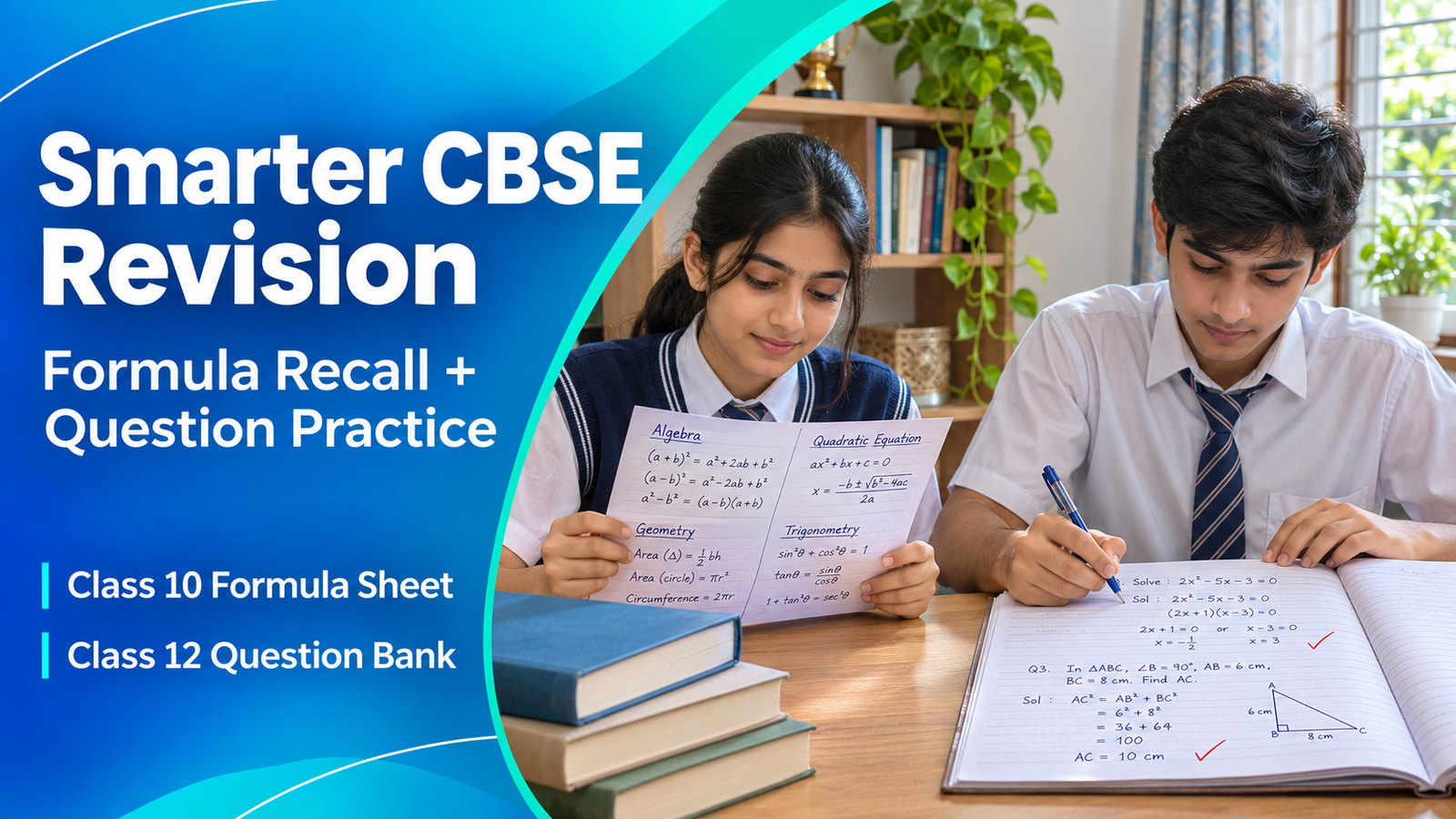


CBSE exam preparation becomes more manageable when students use different study resources for different purposes. A formula sheet can support quick revision, while a question bank can provide structured practice after concepts have been studied.
For Class 10 students, a Class 10 Formula Sheet can be useful for revising important formulas before solving numerical questions. Class 12 students can use a CBSE Class 12 Question Bank to practise questions and identify topics that need additional attention.
The key is not simply to collect these resources. Students need to use them as part of a planned revision and practice routine.
Why Quick Revision Resources Matter
Students often spend considerable time learning chapters but struggle to remember important details later. This is especially common with formulas, definitions, relationships, and problem-solving methods.
A compact revision resource makes it easier to revisit important information regularly.
Instead of waiting until the final days before an examination, students can spend a few minutes reviewing key formulas and concepts after completing their daily study.
This creates repeated exposure without requiring them to reread entire chapters.
How to Use a Class 10 Formula Sheet Effectively
A formula sheet works best when students use it alongside problem-solving.
Review Before Practice
Before starting numerical questions, spend a few minutes reviewing the formulas related to the topic.
Try to recall what each formula represents instead of simply reading it.
Test Your Memory
Close the formula sheet and write down the formulas you remember.
Then compare your answers with the original.
This quickly identifies formulas that require additional revision.
Apply the Formulas
Immediately solve a few questions using the formulas you reviewed.
If you know a formula but cannot identify when to use it, you need more application-based practice.
Don’t Memorise Without Understanding
Memorising formulas without understanding their purpose can create problems during examinations.
Students may remember the equation but choose the wrong formula for a particular question.
For each important formula, understand:
- What each variable represents
- Which type of problem uses it
- What conditions apply
- Which formulas are closely related
- How to rearrange it when necessary
This makes formula recall more practical.
Use Question Banks After Concept Revision
A question bank becomes more useful once you have studied the relevant concepts.
For Class 12 students, a CBSE Class 12 Question Bank can provide additional opportunities to practise different question types.
Instead of solving questions randomly, divide your practice into chapters or topics.
For example:
Chapter Revision → Basic Questions → Application Questions → Mixed Practice → Review
This makes it easier to determine whether you actually understand the chapter.
Analyse Every Incorrect Answer
Do not simply check the correct answer and move on.
For each mistake, identify its cause.
Concept Error
You did not understand the underlying idea.
Action: Return to the relevant theory and revise it.
Formula Error
You forgot or incorrectly applied a formula.
Action: Add the formula to your short revision list and solve related problems.
Calculation Error
Your method was correct, but the arithmetic went wrong.
Action: Practise the calculation carefully and check each step.
Question Interpretation Error
You misunderstood what the question was asking.
Action: Practise identifying important information and conditions before solving.
Create an Error Log
A simple error log can make revision much more efficient.
| Subject | Topic | Mistake | Corrective Action |
|---|---|---|---|
| Mathematics | Algebra | Formula confusion | Revise formulas |
| Physics | Mechanics | Wrong approach | Revisit concept |
| Chemistry | Reactions | Poor recall | Revise reaction patterns |
| English | Grammar | Rule confusion | Practise similar questions |
Review this log every few days.
Repeated mistakes should receive more attention than errors that happened only once.
Combine Active Recall With Question Practice
Simply rereading notes can make information seem familiar without confirming whether you can recall it independently.
Use active recall instead.
After studying a topic, close your book and try to explain:
- Key concepts
- Important formulas
- Definitions
- Processes
- Common question types
Then solve questions without looking at the solution.
This combination tests both memory and application.
Introduce Time Limits Gradually
Once you become comfortable with a topic, start solving questions under time limits.
Do not begin with extreme pressure.
Follow a gradual progression:
Concept Understanding → Accurate Practice → Timed Sets → Mixed Questions → Full-Length Practice
If accuracy drops sharply when you introduce timing, your priority should be improving your solving method rather than simply trying to work faster.
Give More Attention to Weak Chapters
Students often spend too much time revising topics they already understand because those chapters feel comfortable.
A better approach is to classify topics as:
Strong
Maintain them with periodic revision.
Moderate
Practise them regularly to improve consistency.
Weak
Return to the underlying concepts and build confidence through easier questions before moving to advanced problems.
This prevents your study schedule from becoming unbalanced.
Build a Simple Weekly Revision Plan
A practical weekly routine could include:
Monday: Formula and concept revision
Tuesday: Chapter-wise question practice
Wednesday: Weak-topic revision
Thursday: Timed practice
Friday: Error-log review
Saturday: Mixed question practice
Sunday: Weekly revision and self-assessment
Students can adjust the schedule according to their school timetable and examination date.
Avoid Using Too Many Study Resources
Collecting multiple books, notes, websites, and question banks can make preparation unnecessarily complicated.
The goal is not to use every available resource.
Choose reliable material that covers your needs and use it consistently. A smaller collection of well-used resources is generally more useful than a large collection that remains incomplete.
Final Revision Strategy
As examinations approach, focus more on revision and application than on collecting new material.
Class 10 students can use formula-based revision to quickly revisit important equations and then practise related questions. Class 12 students can use question banks to reinforce concepts, identify recurring mistakes, and improve their ability to handle different question formats.
Keep your final revision focused on:
- Important formulas
- Weak chapters
- Frequently made mistakes
- Important concepts
- Timed practice
- Previously difficult questions
Conclusion
A Class 10 Formula Sheet and a CBSE Class 12 Question Bank serve different but complementary purposes. Formula sheets support quick recall, while question banks help students test their understanding through practice.
Neither should replace detailed learning. The most effective approach is to understand the concept first, revise important information, solve relevant questions, analyse mistakes, and revisit weak areas.
When students use these resources consistently rather than simply collecting them, revision becomes more organised and exam preparation becomes more focused.