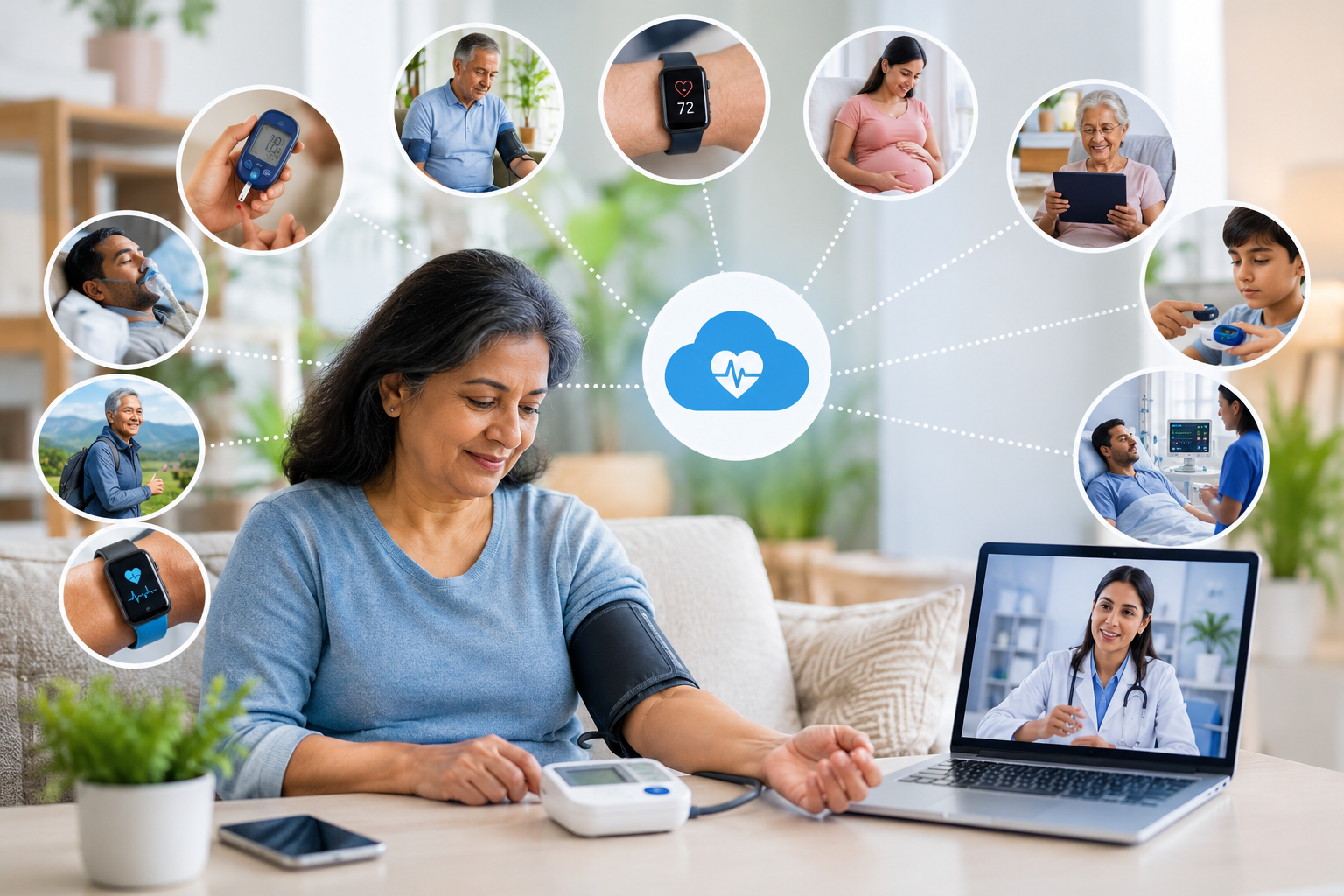


Remote patient monitoring (RPM) and telehealth help healthcare providers deliver care beyond traditional medical settings. Both use digital technology to connect patients with healthcare services, but they serve different purposes. Understanding the difference helps hospitals, clinics, and healthcare organizations choose the right solutions for their patients.
Remote patient monitoring focuses on collecting and sharing patient health data from outside a healthcare facility. Telehealth covers a broader range of healthcare services delivered through digital communication, including virtual consultations, follow-up appointments, and remote care management.
In this guide, we explain how remote patient monitoring and telehealth work, their key differences, their benefits, and how healthcare providers can use both to improve patient care.
What Is Remote Patient Monitoring?
Remote patient monitoring is a healthcare approach that uses connected medical devices to collect patient health information outside a traditional clinical setting. The collected data is transmitted to healthcare providers, allowing them to monitor a patient’s condition and identify potential concerns.
RPM is especially useful for patients who need regular monitoring but do not require frequent in-person appointments.
For example, a patient with high blood pressure may use a connected blood pressure monitor at home. The device records blood pressure readings and sends the information to a healthcare team for review.
Common remote patient monitoring devices include:
-
Blood pressure monitors: Track blood pressure levels at home.
-
Blood glucose meters: Help monitor blood sugar levels in patients with diabetes.
-
Pulse oximeters: Measure blood oxygen saturation.
-
Connected weight scales: Help monitor weight changes, including those relevant to certain heart conditions.
-
Wearable health devices: Track selected health measurements, such as heart rate and activity.
RPM systems can help healthcare professionals identify concerning changes, adjust care plans, and follow up with patients when needed. However, the effectiveness of monitoring depends on accurate measurements, reliable data transmission, and timely clinical review.
What Is Telehealth?
Telehealth uses digital communication and technology to deliver healthcare services remotely. It includes virtual medical consultations, patient education, remote follow-ups, and certain forms of remote clinical support.
Patients can communicate with healthcare professionals using video calls, phone calls, secure messaging, and online healthcare platforms.
For example, a patient experiencing recurring headaches may schedule a video consultation with a doctor. The doctor discusses the symptoms, reviews the patient’s medical history, and recommends appropriate next steps.
Common telehealth services include:
-
Virtual consultations: Patients speak with doctors through video or phone calls.
-
Remote follow-up appointments: Healthcare providers review recovery progress after treatment.
-
Patient education: Medical professionals explain treatment plans and health management practices.
-
Digital prescription management: Providers may issue prescriptions where permitted by applicable regulations.
-
Remote care coordination: Healthcare teams communicate with patients and other providers to coordinate care.
Telehealth reduces the need for some in-person visits and makes healthcare more accessible to patients who face travel, mobility, or scheduling challenges.
Remote Patient Monitoring vs. Telehealth: Key Differences
Although remote patient monitoring and telehealth often work together, they differ in their main functions.
| Comparison | Remote Patient Monitoring | Telehealth |
|---|---|---|
| Primary purpose | Collects and monitors patient health data remotely | Delivers healthcare services through digital communication |
| Main technology | Connected medical devices and monitoring platforms | Video conferencing, phone calls, messaging, and online platforms |
| Patient interaction | May operate continuously or at scheduled intervals without a live consultation | Often involves direct communication with a healthcare professional |
| Data collection | Frequently collects measurements such as blood pressure or glucose levels | May use patient-reported information, medical records, and shared test results |
| Typical use case | Monitoring chronic conditions and tracking health changes | Virtual consultations, follow-ups, and patient education |
| Healthcare response | Providers review readings and respond according to clinical protocols | Providers assess concerns and offer advice or treatment during remote interactions |
| Main benefit | Supports ongoing visibility into selected health measurements | Improves access to healthcare professionals |
The key distinction is that remote patient monitoring focuses on collecting health data, while telehealth focuses on delivering healthcare services remotely. RPM can be part of a broader telehealth program, but the two terms are not interchangeable.
How Does Remote Patient Monitoring Work?
Remote patient monitoring follows a process that connects patients, medical devices, software platforms, and healthcare professionals.
1. A patient uses a connected device
The healthcare provider recommends a suitable monitoring device based on the patient’s condition. The patient uses the device at home or another location to record relevant health measurements.
2. The device collects health data
The device measures information such as blood pressure, blood glucose, oxygen saturation, or weight. Depending on the device, readings may be collected automatically or entered by the patient.
3. Data is transmitted to a monitoring platform
The measurements are transferred through an internet connection, Bluetooth, a mobile network, or another supported connection. The monitoring platform stores and displays the information for authorized healthcare personnel.
4. Healthcare professionals review the readings
Healthcare teams review the data according to established monitoring schedules and clinical protocols. Alerts may identify readings that require additional attention.
5. The provider follows up when necessary
If the information indicates a potential concern, the healthcare team may contact the patient, arrange a consultation, or recommend further assessment.
Reliable connectivity and timely data review are essential. A monitoring device alone cannot guarantee that a concerning reading will be detected or acted upon.
How Does Telehealth Work?
Telehealth uses digital communication tools to connect patients with healthcare professionals without requiring everyone to be in the same physical location.
A typical telehealth appointment follows these steps:
-
Appointment scheduling: The patient books a virtual consultation through a healthcare portal, application, or telephone service.
-
Digital connection: The patient joins the appointment through a supported video, phone, or messaging platform.
-
Patient assessment: The healthcare professional discusses symptoms, reviews available medical information, and evaluates the patient’s concerns.
-
Care recommendations: The provider offers medical guidance, recommends tests, discusses treatment, or schedules an in-person visit when appropriate.
-
Follow-up: The patient receives relevant instructions and information about subsequent appointments or care requirements.
Some telehealth platforms also integrate with electronic health records, remote monitoring devices, and patient management systems. These integrations help healthcare teams access relevant information and coordinate care.
Benefits of Remote Patient Monitoring
Remote patient monitoring offers several benefits for patients and healthcare organizations.
1. Ongoing health monitoring
RPM helps providers track selected health measurements between appointments. This can be particularly valuable for patients managing chronic conditions that require regular observation.
2. Earlier identification of potential problems
Changes in health measurements may alert providers to a developing concern. Early identification can support timely clinical assessment, although it does not guarantee that complications will be prevented.
3. Fewer unnecessary clinic visits
When clinically appropriate, some routine monitoring can take place at home rather than requiring repeated in-person visits.
4. Better-informed care decisions
Consistent readings can help healthcare professionals understand trends over time instead of relying only on measurements taken during occasional appointments.
5. Greater convenience for patients
Patients may find it easier to participate in a monitoring program from home, particularly when travel is difficult or frequent clinic visits create scheduling challenges.
Benefits of Telehealth
Telehealth also improves healthcare access and service delivery.
1. Convenient access to healthcare professionals
Patients can attend eligible consultations remotely, reducing the need to travel for every appointment.
2. Improved access for underserved communities
Virtual services can help connect patients in rural or remote locations with healthcare professionals who may not be readily available nearby.
3. Flexible follow-up care
Providers can conduct suitable follow-up appointments through digital platforms, helping patients maintain contact with their healthcare team.
4. Better care coordination
Digital communication can support collaboration between patients, doctors, specialists, and other members of the care team.
5. More efficient appointment management
Telehealth can help healthcare organizations manage appropriate appointments remotely and reserve in-person capacity for patients who need physical examinations or procedures.
Can Remote Patient Monitoring and Telehealth Work Together?
Yes. In many cases, combining remote patient monitoring with telehealth creates a more connected care experience.
Consider a patient who is managing high blood pressure.
The patient records blood pressure readings at home using a connected monitor. The readings are shared with the healthcare team through an RPM platform. During a scheduled telehealth consultation, the doctor reviews the measurements, discusses symptoms and medication adherence, and determines whether the treatment plan needs to change.
In this example, RPM provides ongoing health data, while telehealth enables direct communication between the patient and the doctor.
Together, these technologies can help healthcare providers:
-
Track health measurements between appointments.
-
Discuss changes in a patient’s condition using recent data.
-
Support follow-up care without requiring every interaction to happen in person.
-
Coordinate treatment and monitoring plans.
-
Improve continuity of care for suitable patients.
However, the two technologies need appropriate workflows, trained staff, and clear escalation procedures to deliver these benefits consistently.
Common Technology Challenges in Remote Patient Monitoring and Telehealth
Both solutions depend on reliable technology. Technical problems can interrupt data collection, delay consultations, and create frustration for patients and healthcare staff.
Common challenges include:
Device connectivity problems
RPM devices may fail to transmit readings because of weak internet connections, Bluetooth pairing issues, depleted batteries, or incorrect device setup.
Software and integration issues
Monitoring platforms and telehealth applications may experience login problems, software errors, or difficulties exchanging information with electronic health record systems.
Patient onboarding difficulties
Some patients need help installing applications, connecting devices, accessing virtual appointments, or understanding how to use digital healthcare tools.
Data security and privacy risks
Healthcare organizations must protect sensitive patient information through appropriate access controls, secure data transmission, system monitoring, and compliance with applicable privacy requirements.
Limited technical support availability
When patients encounter technical issues outside normal business hours, they may struggle to connect their devices or attend scheduled consultations. Delayed technical assistance can disrupt the care process.
Healthcare organizations can address these challenges through clear troubleshooting procedures, staff training, routine system maintenance, and dependable technical support.
How Healthcare IT Support Helps Remote Care Programs
Healthcare IT support plays an important role in keeping remote patient monitoring and telehealth systems accessible and reliable.
Support teams can help healthcare organizations troubleshoot device connectivity issues, resolve software access problems, assist with application setup, and escalate more complex technical incidents.
Depending on the service arrangement, support may also include monitoring system availability, documenting recurring incidents, assisting with device onboarding, and coordinating with software or device vendors.
Outsourced IT support can be an option for healthcare organizations that need additional technical assistance without expanding their internal IT team for every support requirement. The scope of support should be clearly defined, particularly when clinical decisions, protected health information, and regulated systems are involved.
It is also important to distinguish technical support from clinical monitoring. Technical support teams can help restore system access and resolve technology issues, but clinical staff remain responsible for interpreting health readings and responding to medical concerns unless a separate, appropriately authorized clinical service is in place.
For healthcare providers using connected medical devices and digital care platforms, reliable technical support helps maintain the technology infrastructure needed to deliver remote services.
How to Choose Between Remote Patient Monitoring and Telehealth
The right solution depends on the healthcare organization’s goals, patient population, and care delivery model.
Choose remote patient monitoring when your organization needs to collect health measurements between appointments, monitor selected chronic conditions, or track patient progress over time.
Choose telehealth when patients need virtual consultations, medical guidance, follow-up appointments, or remote communication with healthcare professionals.
Consider using both when your organization needs ongoing health data collection alongside regular virtual consultations.
Before implementation, evaluate device compatibility, platform security, internet access, patient usability, clinical workflows, staffing requirements, and ongoing technical support needs. Healthcare providers should also establish clear procedures for reviewing incoming data, responding to alerts, and handling technology failures.
Conclusion
Remote patient monitoring and telehealth both support modern healthcare delivery, but they serve different purposes. Remote patient monitoring collects patient health data outside clinical settings, while telehealth enables healthcare professionals to deliver consultations, follow-up care, and other services remotely.
For many healthcare organizations, combining both approaches can support better-connected care and more convenient patient experiences. However, success depends on reliable devices, secure platforms, effective clinical workflows, and accessible technical assistance.
Healthcare providers implementing these solutions should consider how healthcare IT support can help resolve technical issues, maintain system availability, and support the digital infrastructure behind remote care programs.