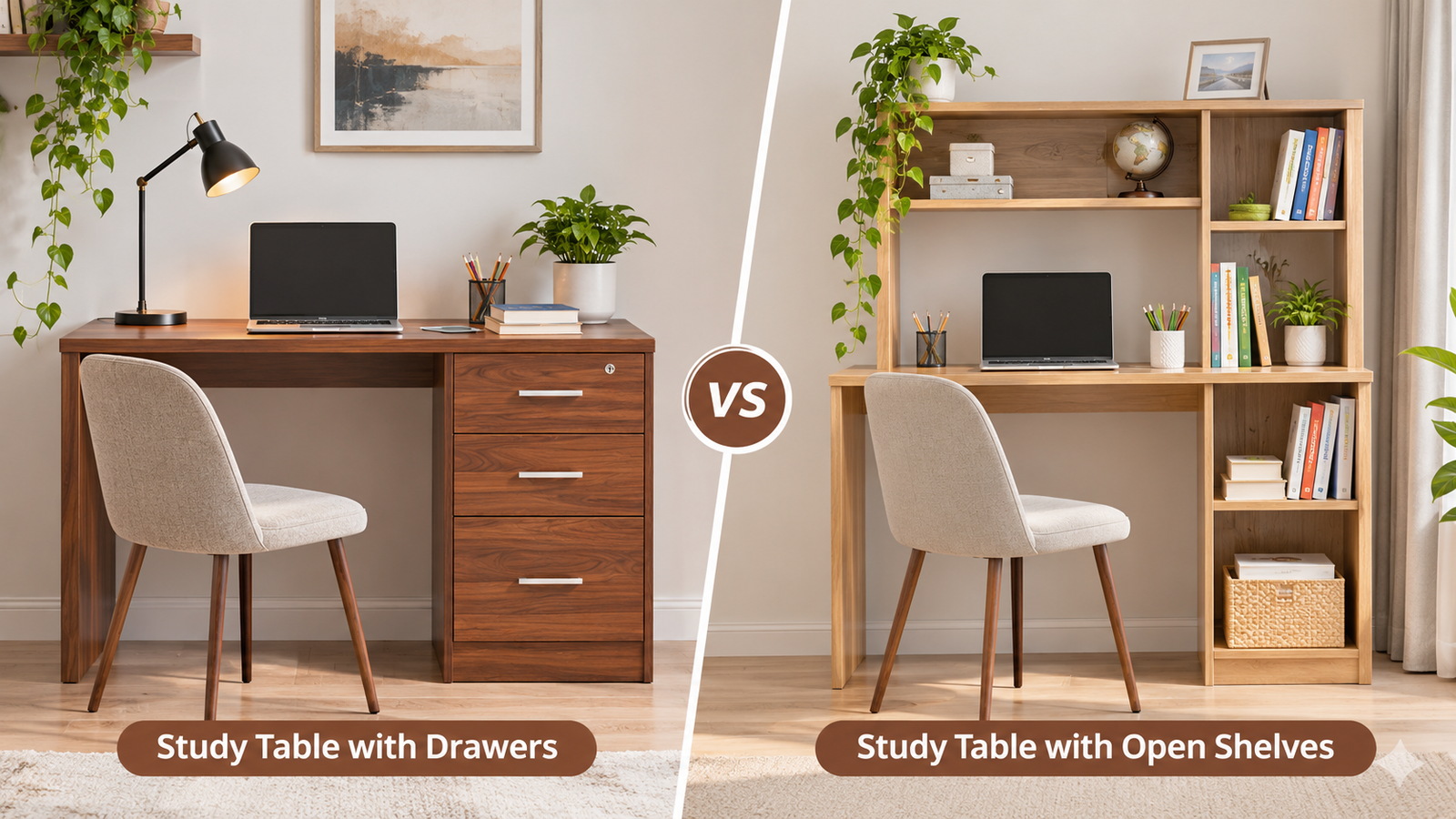


Choosing a study table involves more than finding a design that matches your room. The storage layout, available workspace, accessibility and overall functionality determine how comfortable and organised your daily routine will be. Two popular options among students, working professionals and homeowners are study tables with drawers and study tables with open shelves.
While drawers provide concealed storage for stationery, documents and personal belongings, open shelves offer convenient access to books, files and frequently used accessories. Both designs serve different purposes, and choosing the right one depends on your working habits, storage requirements, room size and budget.
If you are planning to buy a study table online, understanding the practical differences between these designs can help you make a worthwhile furniture investment.
What Is a Study Table with Drawers?
A study table with drawers features enclosed storage compartments integrated beneath the tabletop or along one side of the furniture. Depending on the design, it may include multiple drawers of different sizes to accommodate everyday essentials.
These tables are particularly suitable for people who prefer a clean, organised workspace without displaying everything they own.
Benefits of a Study Table with Drawers
1. Keeps the Workspace Clutter-Free
Drawers provide dedicated storage for stationery, notebooks, chargers, calculators and other small accessories. Instead of leaving these items scattered across the tabletop, you can store them neatly and maintain sufficient space for studying or working.
2. Provides Better Privacy
Personal documents, certificates, diaries and confidential office paperwork can be stored away from immediate view. Models with lockable drawers may provide additional privacy when required.
3. Reduces Dust Accumulation
Enclosed compartments reduce direct exposure to dust compared to open storage. This can be particularly useful for storing documents, electronic accessories and items that are not used every day.
4. Creates a Clean and Professional Appearance
A wooden study table with drawers complements contemporary bedrooms, home offices and minimalist interiors. Concealed storage helps maintain a visually organised environment even when you have several accessories to store.
5. Makes Small Items Easier to Organise
Separate drawers can be assigned to different categories of belongings. For example, you can dedicate one drawer to stationery, another to electronic accessories and a third to important paperwork.
Limitations of Study Tables with Drawers
Although drawers offer practical advantages, there are certain limitations to consider:
-
Large textbooks and oversized files may not fit inside shallow drawers.
-
Side-mounted drawer units can reduce available legroom.
-
Drawer handles and sliding mechanisms may require occasional maintenance.
-
Additional clearance is necessary to open drawers comfortably.
-
Multiple enclosed compartments may increase the overall furniture cost.
Before purchasing, check the internal drawer dimensions rather than relying only on the external appearance of the table.
What Is a Study Table with Open Shelves?
A study table with open shelves includes exposed storage compartments positioned beside, above or underneath the tabletop. These shelves are designed to accommodate books, folders, decorative accessories and frequently used study materials.
Unlike drawers, open shelves allow you to see and retrieve stored items without opening a compartment.
Benefits of a Study Table with Open Shelves
1. Offers Quick Access to Everyday Essentials
Students who frequently refer to textbooks, reference materials and notebooks can benefit from accessible shelving. Everything remains visible and within reach, reducing interruptions during study sessions.
2. Accommodates Larger Items
Depending on shelf dimensions and load capacity, open compartments can accommodate textbooks, storage baskets, document folders and other items that may not fit inside standard drawers.
3. Utilises Vertical Space Efficiently
A study table with overhead shelves can provide additional storage without significantly increasing its floor footprint. This makes it a practical option for compact bedrooms, apartments and dedicated study corners.
4. Allows Personalisation
Open shelving gives you the flexibility to display decorative accessories, photographs, small indoor plants and other personal belongings alongside functional study materials.
5. Simplifies Storage Management
Visible storage makes it easier to identify missing items, monitor available space and rearrange belongings according to changing requirements.
Limitations of Study Tables with Open Shelves
Open shelving also comes with certain drawbacks:
-
Books and accessories are more exposed to dust.
-
Poorly arranged shelves can create visual clutter.
-
Personal documents remain visible unless stored in separate organisers.
-
Overhead shelves may restrict monitor placement if clearance is insufficient.
-
Heavy books require shelves with suitable load-bearing capacity.
Open shelving works best when you maintain an organised storage system and clean the compartments regularly.
Study Table with Drawers vs Open Shelves: Key Differences
1. Storage Capacity and Organisation
The effectiveness of a study table with storage depends on the type of belongings you need to accommodate.
Drawers are better suited for smaller accessories, loose documents, stationery and personal belongings. Open shelves are generally more practical for books, large folders and frequently accessed materials.
For example, a school student with several textbooks may benefit more from open shelves, while a professional managing paperwork and electronic accessories may find drawers more useful.
2. Accessibility and Convenience
Open shelves offer immediate access to stored belongings. You can retrieve a textbook or reference folder without opening and closing a compartment.
Drawers require an additional step but provide better separation between different categories of items. Shallow top drawers are particularly useful for accessories that would otherwise get lost among larger belongings.
Consider how often you access each item before deciding which storage design suits your routine.
3. Space Utilisation
Both designs can work well in small rooms, provided their dimensions match the available space.
A study table with overhead shelves makes use of vertical space, while a compact table with drawers can provide concealed storage without requiring a separate cabinet.
However, bulky drawer pedestals may restrict seating space. Similarly, deep side shelves can increase the overall width of the furniture.
Measure the available floor area, chair clearance and wall height before selecting a design.
4. Appearance and Interior Compatibility
Drawers are ideal for homeowners who prefer minimalist furniture and clean surfaces. Their enclosed design helps create a more uniform appearance.
Open shelves are suitable for interiors where books, decorative objects and personal accessories contribute to the overall aesthetic.
Finishes such as natural oak, walnut and dark wood tones can complement different interior styles. Choose a finish that coordinates with your existing furniture rather than considering the study table in isolation.
5. Cleaning and Maintenance
Open shelves generally require more frequent dusting because stored items remain exposed. However, their accessible design makes cleaning the compartments relatively straightforward.
Drawers require less frequent internal dusting but may accumulate small debris over time. Their sliding mechanisms should also be checked periodically for smooth operation.
If low-maintenance storage is a priority, enclosed compartments may be the more convenient choice.
6. Pricing and Long-Term Value
A study table with drawers may cost more than a comparable open-shelf design because drawers require additional panels, handles, sliding hardware and assembly.
However, pricing also depends on the furniture’s dimensions, material, finish, construction quality and storage configuration.
A large study table with multiple reinforced shelves may cost more than a compact table with a single drawer. Therefore, compare overall functionality rather than assuming one storage design is always more affordable.
Which Study Table Is Best for Different Users?
For School and College Students
Students often need space for textbooks, notebooks, stationery and reference materials. A study table with open shelves provides convenient access to these essentials.
A combination of shelves and at least one drawer can be particularly practical for keeping books accessible while storing pens, calculators and examination materials separately.
For Working Professionals
Working professionals typically require sufficient tabletop space for laptops, monitors, keyboards and office accessories.
A study table with drawers can help keep chargers, documents and personal belongings organised without occupying the primary working surface.
If your work involves frequent access to physical files, consider a design that combines drawers with accessible shelving.
For Small Bedrooms and Apartments
Compact study tables with vertical shelving can help maximise storage without occupying additional floor space.
However, if the bedroom already contains wardrobes and bookshelves, a simple study table with drawers may be sufficient. Avoid purchasing additional storage that duplicates furniture you already own.
For Shared Workspaces
When multiple family members use the same study table, drawers can provide separate compartments for individual belongings.
Open shelves can accommodate shared books and reference materials, while enclosed storage helps prevent personal accessories from becoming mixed together.
For Creative Professionals
Designers, artists and other creative professionals may need storage for sketchbooks, tools and craft materials.
Open shelves are useful for larger supplies, while drawers provide organised storage for smaller tools. A hybrid study table is often the more flexible option for these requirements.
Important Factors to Consider Before Buying a Study Table
1. Measure the Available Space
Start by measuring the area where you intend to place the furniture.
A tabletop approximately 90–120 cm wide can accommodate many standard study and laptop setups, while a depth of around 50–60 cm may be suitable for everyday tasks. Larger monitor setups may require additional depth.
These measurements are general guidelines. Your ideal dimensions depend on your equipment, seating arrangement and working preferences.
Remember to account for drawer opening clearance, chair movement and access to nearby furniture.
2. Evaluate the Material and Construction Quality
The material of a study table influences its durability, appearance, maintenance requirements and price.
Engineered wood is a popular option for modern study tables because it offers various finishes and storage configurations across different price ranges.
When comparing products, examine:
-
Tabletop thickness and construction.
-
Shelf support and load-bearing capacity.
-
Edge finishing and surface quality.
-
Drawer sliding mechanisms.
-
Stability of the overall structure.
-
Manufacturer’s care and assembly instructions.
A well-constructed table with fewer compartments may provide better long-term value than a larger design with poor-quality fittings.
3. Check Legroom and Seating Comfort
Storage should not compromise seating comfort.
A drawer positioned directly beneath the tabletop may reduce thigh clearance, while a side-mounted storage unit can restrict movement.
Check the distance between the storage compartments and your chair. A suitable study table should allow you to sit comfortably, keep your feet supported and position your arms naturally while working.
4. Consider Your Actual Storage Requirements
Before shopping, identify everything you regularly keep around your workspace.
If most of your belongings consist of books and folders, open shelves may be sufficient. If you primarily use digital devices and small accessories, drawers may provide more relevant storage.
Avoid choosing a table simply because it has numerous compartments. Unnecessary storage can increase the cost and make the furniture bulkier.
5. Look for Cable Management Options
If you use a laptop, desktop computer, desk lamp or charging accessories, consider how cables will be arranged.
Study tables with cable openings, accessible rear panels or suitable clearance against the wall can help manage wires more effectively.
Avoid designs where storage compartments obstruct electrical outlets or make charging devices inconvenient.
6. Compare the Total Purchase Cost
When buying a study table online, consider more than the listed selling price.
Check delivery charges, assembly requirements, warranty coverage and return policies. If you select an open-shelf design, consider whether additional storage baskets or organisers will be necessary.
While exploring study table designs from DeckUp, compare product dimensions, material specifications, storage configurations and available finishes to identify an option that meets your practical requirements and budget.
Is a Study Table with Both Drawers and Open Shelves a Better Choice?
A study table that combines drawers and open shelves can offer a balanced solution for users with varied storage requirements.
The drawers provide concealed space for stationery, documents and personal accessories, while the shelves accommodate books, folders and frequently used materials.
This combination is particularly useful for students who also use computers, professionals working from home and households where the same furniture serves multiple purposes.
However, combination designs may require additional space and come at a higher price. If your storage needs are limited, a simpler design may offer better value.
Choose a hybrid study table when you genuinely need both accessible and concealed storage rather than purchasing additional compartments purely for appearance.
Common Mistakes to Avoid When Buying a Study Table
Even an attractive study table can become inconvenient if it does not suit your everyday requirements. Avoid these common purchasing mistakes:
-
Ignoring internal storage dimensions: Check whether your books, files and accessories will actually fit inside the compartments.
-
Overlooking drawer clearance: Ensure drawers can open fully without hitting your chair, bed or nearby furniture.
-
Choosing appearance over functionality: Prioritise workspace comfort, accessibility and storage requirements.
-
Buying excessive storage: Additional compartments can increase furniture size and cost unnecessarily.
-
Ignoring shelf load capacity: Confirm that shelves can safely support the weight of your books and accessories.
-
Overlooking monitor clearance: Check whether overhead shelves leave sufficient space for your computer screen.
-
Not checking assembly requirements: Understand whether the product requires self-assembly or professional installation before ordering.
Taking these factors into account can help you avoid unnecessary expenses and select furniture that remains practical as your requirements evolve.
Frequently Asked Questions
1. Which is better, a study table with drawers or open shelves?
A study table with drawers is better for concealed storage, small accessories and personal documents. Open shelves are more suitable for books, folders and frequently used materials. The right choice depends on your storage requirements and working habits.
2. Is a study table with drawers suitable for small rooms?
Yes, a compact study table with drawers can be suitable for small rooms. Choose a design that provides sufficient legroom and drawer-opening clearance without obstructing movement around the room.
3. Which study table design is best for students?
A study table with open shelves and a dedicated drawer is a practical option for many students. It allows easy access to textbooks while providing separate storage for stationery and personal belongings.
4. Are study tables with drawers more expensive than open-shelf tables?
Drawer-based designs may cost more because of additional materials and hardware. However, the final price depends on dimensions, construction quality, material, finish and the number of storage compartments.
5. Is engineered wood suitable for a study table?
Engineered wood can be a practical choice for everyday study and home office furniture. Its suitability depends on material quality, panel thickness, construction, surface finish and proper maintenance.
6. How much storage should a study table have?
The ideal storage capacity depends on the number and type of items you use regularly. A single drawer may be sufficient for a laptop-based workspace, while students with multiple textbooks may require several shelves.
7. Can a study table with open shelves be used as a computer table?
Yes, provided it offers adequate tabletop dimensions, monitor clearance, cable management and seating space. Check that the shelving arrangement does not interfere with your computer setup.
8. What should I check before buying a study table online?
Check the overall dimensions, internal storage measurements, material, shelf load capacity, drawer hardware, legroom, assembly requirements, warranty and return policy before placing an order.
Conclusion
Choosing between a study table with drawers and open shelves ultimately depends on how you use your workspace. Drawers are ideal for maintaining a clean appearance, organising smaller accessories and keeping personal belongings out of sight. Open shelves offer convenient access to books, efficient vertical storage and flexibility for displaying frequently used materials.
If your daily routine involves a combination of books, documents, electronic devices and stationery, a study table featuring both storage options may provide greater functionality.
Before making your purchase, evaluate your room dimensions, seating comfort, storage requirements, material preferences and budget. A thoughtfully selected study table can help you maintain an organised and comfortable workspace without investing in unnecessary furniture.
Explore the range of study table designs from DeckUp and compare storage layouts, finishes and dimensions to find a practical furniture solution that complements your home and everyday routine.