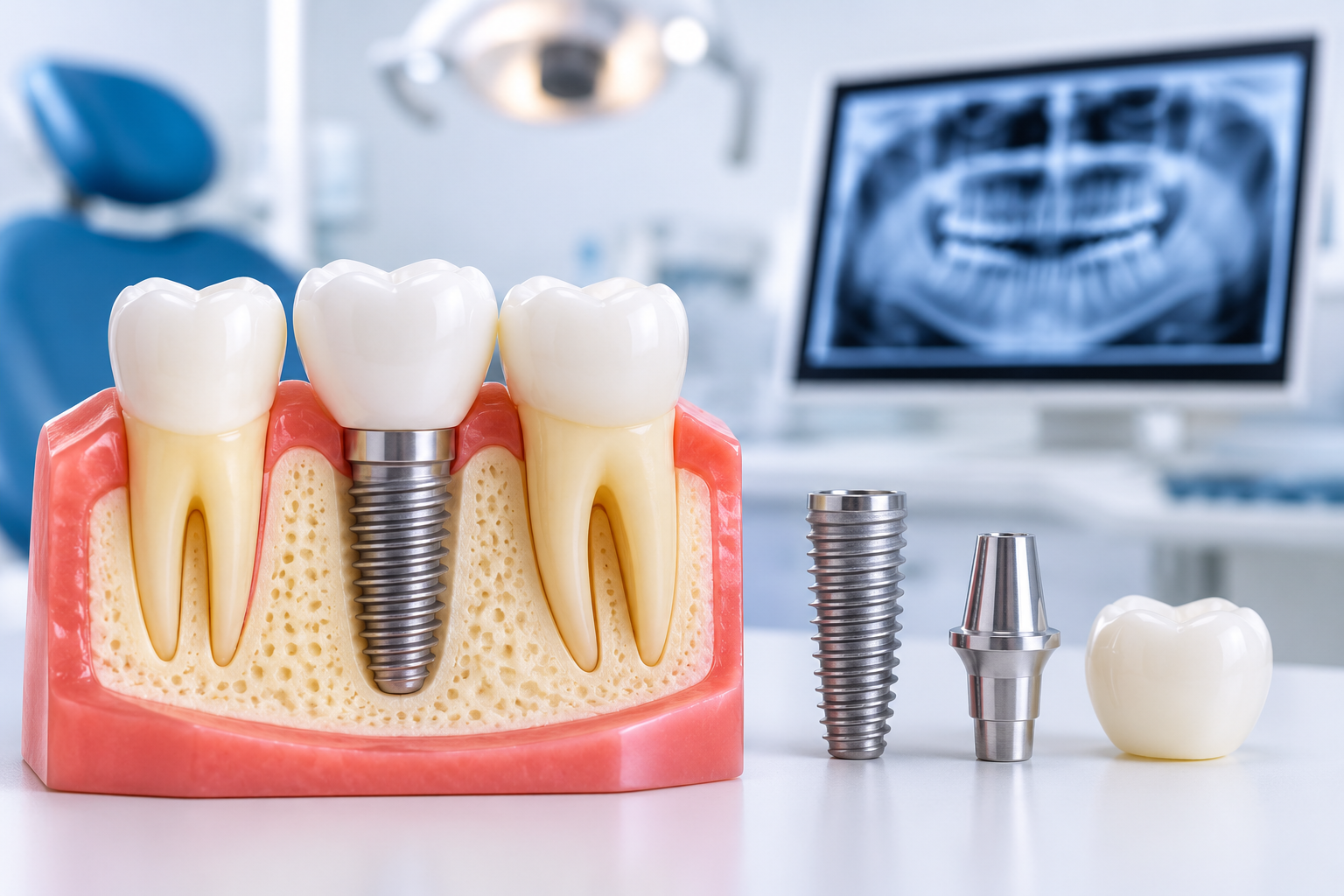


Dental implants replace a missing tooth from the root upwards, using a titanium or zirconia post fixed into the jawbone to hold a crown, bridge or denture. An unfilled gap shrinks the supporting jawbone and lets neighbouring teeth drift. Implant formats vary from a single fixture to a full arch; the surgery restores chewing force, and price follows fixture count and crown material.
What Are Dental Implants?
A dental implant is a screw-shaped titanium or zirconia fixture that a surgeon places into the jawbone as an artificial tooth root. Bone cells grow onto its surface over the following months, a process called osseointegration.
Three parts form the restoration. The fixture is placed inside the bone and carries the chewing load. The abutment screws into it and projects just above the gum line. A crown, bridge or denture then attaches to the abutment. Because the fixture anchors in bone rather than clasping onto neighbouring teeth, tooth replacement implants transfer bite force like a natural root.
Different Types of Dental Implants
Six implant formats cover most clinical situations. Selection depends on the number of missing teeth, available jawbone volume, and when the replacement tooth is fitted.
Single Tooth Implants
A single tooth implant restores one gap with one fixture and one crown. Neighbouring teeth stay untouched, unlike a bridge that needs two of them crowned.
Multiple Tooth Implants
Two or three missing teeth in one stretch of jaw need less fixtures than teeth: two implants carry a three-unit bridge.
Full Mouth Dental Implants
Full mouth dental implants rebuild a complete upper or lower arch on six to eight fixtures. Long-standing tooth loss often calls for grafting first.
All-on-4 and All-on-6 Implants
The All-on-4 protocol carries a full arch on four fixtures: two vertical at the front, two tilted up to 45 degrees at the back to reach denser bone. All-on-6 uses six.
Immediate Load Dental Implants
Immediate load dental implants take a temporary crown on the day of surgery, subject to primary stability of roughly 35 to 45 Ncm insertion torque.
Implant-Supported Dentures
An implant-supported denture locks onto two to four fixtures. Some designs clip out for cleaning.
Dental Implant Surgery: Step-by-Step Procedure
Dental implant surgery differ across several appointments over three to nine months, with most of that period given to bone healing.
- Initial dental consultation and examination: The dentist records medical history, checks gum health and measures the space.
- X-rays and 3D dental scans: A CBCT scan maps bone height, width and the position of nerves and sinuses.
- Implant placement in the jawbone: Under local anaesthesia, the surgeon opens the gum, prepares a channel and threads in the fixture, usually within 30 to 60 minutes.
- Healing and osseointegration: Bone grows onto the fixture over about four months in the lower jaw and six in the upper jaw.
- Abutment placement and crown fitting: The dentist attaches the abutment, takes a digital scan and fits the permanent crown two to three weeks later.
- Follow-up visits and recovery: Reviews at one week, three months and twelve months track gum condition and bone levels.
Benefits of Dental Implant Surgery
Implants hold an advantage on two counts: function and bone preservation. Six key advantages stand out when weighing dental implant solutions against a bridge or a denture.
- Natural appearance and comfortable fit:. The laboratory shade-matches the crown to the adjacent teeth, and nothing covers the palate.
- Improved chewing and speaking ability: A fixed implant returns bite force close to a natural tooth, well above what a denture allows.
- Support for jawbone health: Chewing load through the fixture keeps alveolar bone active. Without a root, ridge width falls roughly 50% within twelve months of extraction.
- Prevention of shifting adjacent teeth: Teeth tilt towards an open space and the opposing tooth over-erupts into it. A fixture holds the gap.
- Long-term tooth replacement solution: Integrated implants show five-year survival between 93% and 98%, and more than 90% remain in function at ten years.
- Improved confidence and smile aesthetics: Satisfaction surveys report approval above 90% past the ten-year mark.
Dental Implant Cost: What Affects the Price?
Dental implant surgery in Mumbai is quoted at approximately 25,000 to 90,000 rupees for a single tooth with its crown, and from about 300,000 rupees for a full arch. Six variables explain the spread.
- Number of implants required: One gap needs one fixture, a full arch of four to eight.
- Type and material of implant: Premium systems with treated surfaces cost two to three times more per fixture than entry-level titanium.
- Dental clinic and specialist expertise: An implantologist with surgical training and in-house imaging charges more than a general practice.
- Bone grafting or additional procedures: A graft, sinus lift or ridge augmentation adds cost and four to nine months of healing.
- Crown material and restoration type: Zirconia crowns cost more than metal-ceramic and screw-retained bridges above cemented crowns.
- Diagnostic scans and follow-up care: CBCT imaging, surgical guides and scheduled reviews are often billed separately.
Who Is a Suitable Candidate for Dental Implants?
Dental implant treatment suits most adults missing one tooth, several teeth or a full arch, provided the jaw can hold a fixture. Bone height and width determine candidacy, and a CBCT scan measures both in one appointment.
Gum health carries as much weight as bone volume. Periodontal disease needs treatment before placement, with daily brushing and interdental cleaning afterwards. Uncontrolled diabetes, heavy smoking and radiotherapy to the jaw all slow healing. A full clinical and radiographic evaluation confirms suitability.
Dental Implant Recovery and Aftercare
Soft tissue closes over the surgical site within seven to ten days, while bone integration continues for months. Swelling and tenderness peak at about 48 hours and settle within three to five days.
Gentle cleaning begins 24 hours after surgery: a soft brush away from the site, the prescribed rinse over it. Soft food for the first two weeks keeps pressure off the fixture, and chewing on the opposite side helps. Once the crown goes on, a review and professional clean every six months keeps the surrounding tissue healthy.
Dental Implants vs Other Tooth Replacement Options
Three routes replace a missing tooth: an implant, a fixed bridge or a removable denture. The table compares them on stability, maintenance and working life.
| Factor | Dental implants | Dental bridges | Removable dentures |
| Support | Jawbone | Two crowned adjacent teeth | Gum ridge and clasps |
| Adjacent teeth | Untouched | Two ground down | Clasps load them |
| Jawbone | Stays stimulated | Continues to resorb | Continues to resorb |
| Stability | Near-natural bite force | Fixed | Moves; adhesive often needed |
| Maintenance | Brush and floss as normal | Floss threader needed | Remove and soak nightly |
| Working life | 10 years and beyond | 7 to 15 years | 5 to 8 years |
Conclusion
Implant choice follows the gap: one fixture for a single tooth, four to six for a full arch, with immediate loading reserved for firm primary stability. Price tracks fixture count, implant system and grafting needs. A clinical examination with a CBCT scan turns these figures into a treatment plan.