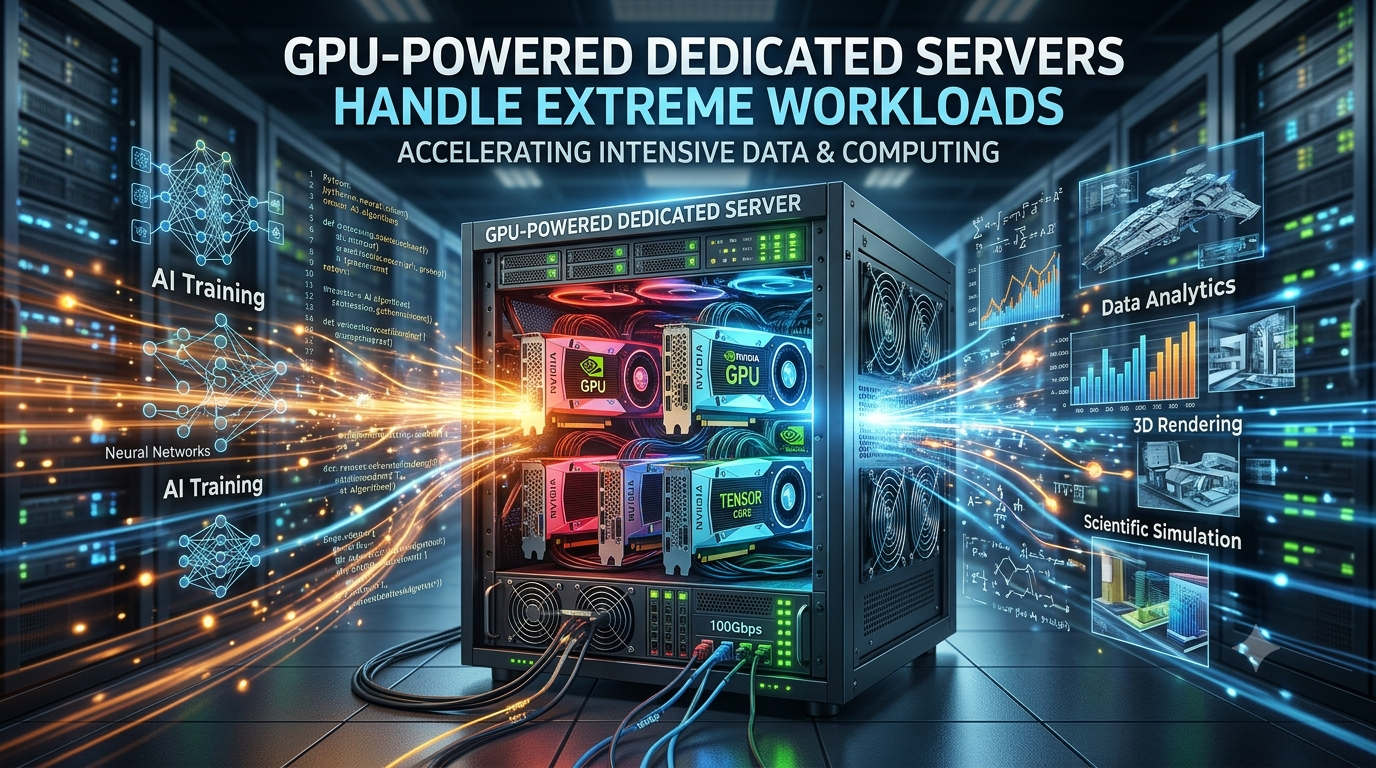


Modern businesses generate and process more data than ever before. From artificial intelligence and machine learning to scientific simulations and high-resolution rendering, today’s workloads demand computing power that traditional servers often struggle to deliver. As organizations continue to adopt data-intensive technologies, the need for specialized infrastructure has become increasingly important.
This is where GPU-powered dedicated servers come into play. By combining the exclusivity of dedicated hosting with the parallel processing capabilities of Graphics Processing Units (GPUs), these servers can handle complex computational tasks significantly faster than conventional CPU-based systems.
In this article, we’ll explore how GPU dedicated servers manage extreme workloads and why they have become a preferred solution for organizations that require high-performance computing.
Understanding GPU-Powered Dedicated Servers
A GPU-powered dedicated server is a physical server equipped with one or more Graphics Processing Units alongside traditional CPUs. While CPUs are designed to handle a wide range of sequential tasks, GPUs are optimized for performing thousands of calculations simultaneously.
This ability to execute multiple operations in parallel makes GPUs exceptionally effective for workload types that involve large datasets, advanced mathematical calculations, graphics processing, and artificial intelligence.
Because the server is fully dedicated to a single user or organization, all resources are available exclusively for their projects, ensuring maximum performance and reliability.
Why Traditional Servers Struggle with Extreme Workloads
Conventional servers rely primarily on CPUs for processing. While modern CPUs are powerful and versatile, they are designed to execute a limited number of tasks at high speed.
Many modern applications require the processing of millions of calculations simultaneously. Examples include:
- Training machine learning models
- Running scientific simulations
- Processing video content
- Rendering 3D environments
- Performing advanced analytics
- Managing large-scale datasets
These workloads can quickly overwhelm CPU-based systems, resulting in longer processing times and reduced efficiency.
GPU-powered servers address this challenge by distributing tasks across thousands of GPU cores, dramatically accelerating performance.
Parallel Processing: The Key Advantage
The primary reason GPU-powered servers excel at extreme workloads is parallel processing.
A CPU may have a relatively small number of highly capable cores designed to perform complex tasks sequentially. A GPU, on the other hand, contains thousands of smaller cores designed to work simultaneously.
This architecture allows GPUs to process massive amounts of data at the same time rather than handling tasks one after another.
For workloads involving repetitive calculations, the performance difference can be remarkable. Tasks that might take hours on a traditional server can often be completed in a fraction of the time using GPU acceleration.
Accelerating Artificial Intelligence and Machine Learning
Artificial intelligence and machine learning are among the most demanding computing workloads in modern business.
Training AI models requires processing vast datasets while performing countless mathematical operations. GPU-powered dedicated servers significantly reduce training times by executing these calculations in parallel.
This enables organizations to:
- Develop AI models faster
- Improve experimentation cycles
- Analyze larger datasets
- Accelerate model deployment
- Increase productivity for data science teams
As AI adoption continues to grow, GPU infrastructure has become a critical component of modern development environments.
Supporting Big Data Analytics
Businesses today collect information from websites, applications, customer interactions, IoT devices, and operational systems.
Extracting valuable insights from these datasets requires substantial computational power. GPU-powered servers can process large volumes of data much faster than traditional servers, enabling businesses to generate reports, identify trends, and make informed decisions more quickly.
Faster analytics helps organizations respond to market conditions, customer behavior, and operational challenges in real time.
Enhancing Video Rendering and Content Creation
Creative industries often work with resource-intensive applications that require significant processing power.
Video editing, animation production, visual effects creation, and 3D rendering all demand substantial computational resources. GPU-powered dedicated servers accelerate rendering processes by distributing graphical calculations across thousands of cores.
This allows creative professionals to complete projects faster while maintaining high-quality output.
For studios and agencies managing large production workloads, GPU acceleration can dramatically improve workflow efficiency.
Powering Scientific and Engineering Simulations
Many industries rely on simulations to model complex systems and predict outcomes.
Examples include:
- Engineering design validation
- Weather forecasting
- Financial modeling
- Biomedical research
- Aerospace simulations
- Manufacturing analysis
These workloads often involve millions of variables and calculations. GPU-powered dedicated servers provide the processing capability needed to complete simulations efficiently while maintaining accuracy.
Faster simulations help organizations reduce development timelines and improve research outcomes.
Delivering Better Performance for High-Demand Applications
Certain business applications require continuous access to high-performance computing resources.
Applications involving:
- Image recognition
- Predictive analytics
- Computer vision
- Data modeling
- Geographic information systems
- Advanced research platforms
All benefit from GPU acceleration.
Dedicated GPU resources help ensure stable performance while supporting demanding computational workloads without interruptions.
This level of performance becomes increasingly important as organizations continue adopting data-driven technologies.
Scalability for Growing Workloads
Technology requirements rarely remain static. As businesses expand and applications become more sophisticated, infrastructure needs naturally increase.
GPU-powered dedicated servers provide flexibility that supports evolving workloads. Organizations can deploy more powerful GPU configurations to accommodate increasing processing demands without redesigning their entire infrastructure.
This scalability allows businesses to support future growth while maintaining performance standards.
Improved Resource Isolation and Reliability
One advantage of dedicated hosting is complete resource isolation.
Unlike shared environments where resources are distributed among multiple users, dedicated servers provide exclusive access to hardware. This eliminates the risk of neighboring workloads affecting performance.
For organizations running mission-critical applications, consistent access to computing resources helps ensure reliable operations and predictable performance.
When combined with GPU acceleration, dedicated infrastructure delivers both power and stability.
Why Businesses Are Moving Toward GPU-Powered Infrastructure
As technologies such as artificial intelligence, machine learning, automation, and data analytics become central to business operations, traditional hosting environments are often unable to keep pace.
Organizations are increasingly investing in GPU-powered infrastructure because it supports:
- Faster processing times
- Improved operational efficiency
- Better scalability
- Accelerated innovation
- Enhanced user experiences
- Reduced project completion times
These benefits make GPU-powered dedicated servers an attractive option for organizations seeking a competitive advantage.
Choosing the Right GPU Dedicated Server with OwnWebServers
Selecting the right GPU dedicated server from OwnWebServers depends on your workload requirements, application types, expected growth, and budget considerations.
When evaluating GPU dedicated server solutions, consider the following factors:
- GPU Model and Performance: Choose a GPU that delivers the processing power required for AI, machine learning, deep learning, rendering, and other GPU-intensive workloads.
- Available RAM and Storage: Ensure sufficient memory and high-speed storage to support demanding applications and large datasets.
- Processor Specifications: Select a powerful CPU that complements GPU performance and ensures efficient workload management.
- Network Connectivity: Look for reliable, high-speed network connectivity to support seamless data transfer and uninterrupted operations.
- Scalability Options: Choose flexible infrastructure that allows you to upgrade resources as your business and computing requirements grow.
- Security Features: Prioritize robust security measures to protect sensitive data, applications, and workloads.
- Technical Support: Reliable technical assistance is essential for maintaining server performance and minimizing downtime.
OwnWebServers offers infrastructure solutions designed to support demanding computing requirements. Choosing the right GPU dedicated server with flexible configurations, reliable performance, and scalable resources can help businesses optimize workloads and maximize long-term infrastructure value.
Final Thoughts
GPU-powered dedicated servers have transformed the way businesses handle extreme workloads. By leveraging parallel processing capabilities, they deliver significantly faster performance for artificial intelligence, machine learning, big data analytics, rendering, simulations, and other resource-intensive applications.
As organizations continue adopting technologies that demand greater computing power, GPU infrastructure is becoming an essential component of modern IT strategies. Businesses that invest in GPU-powered dedicated servers gain the ability to process data faster, innovate more efficiently, and support increasingly complex workloads with confidence.
For companies working with high-performance applications, GPU-powered dedicated hosting is no longer simply an upgrade. It is rapidly becoming a necessity for staying competitive in a technology-driven world.