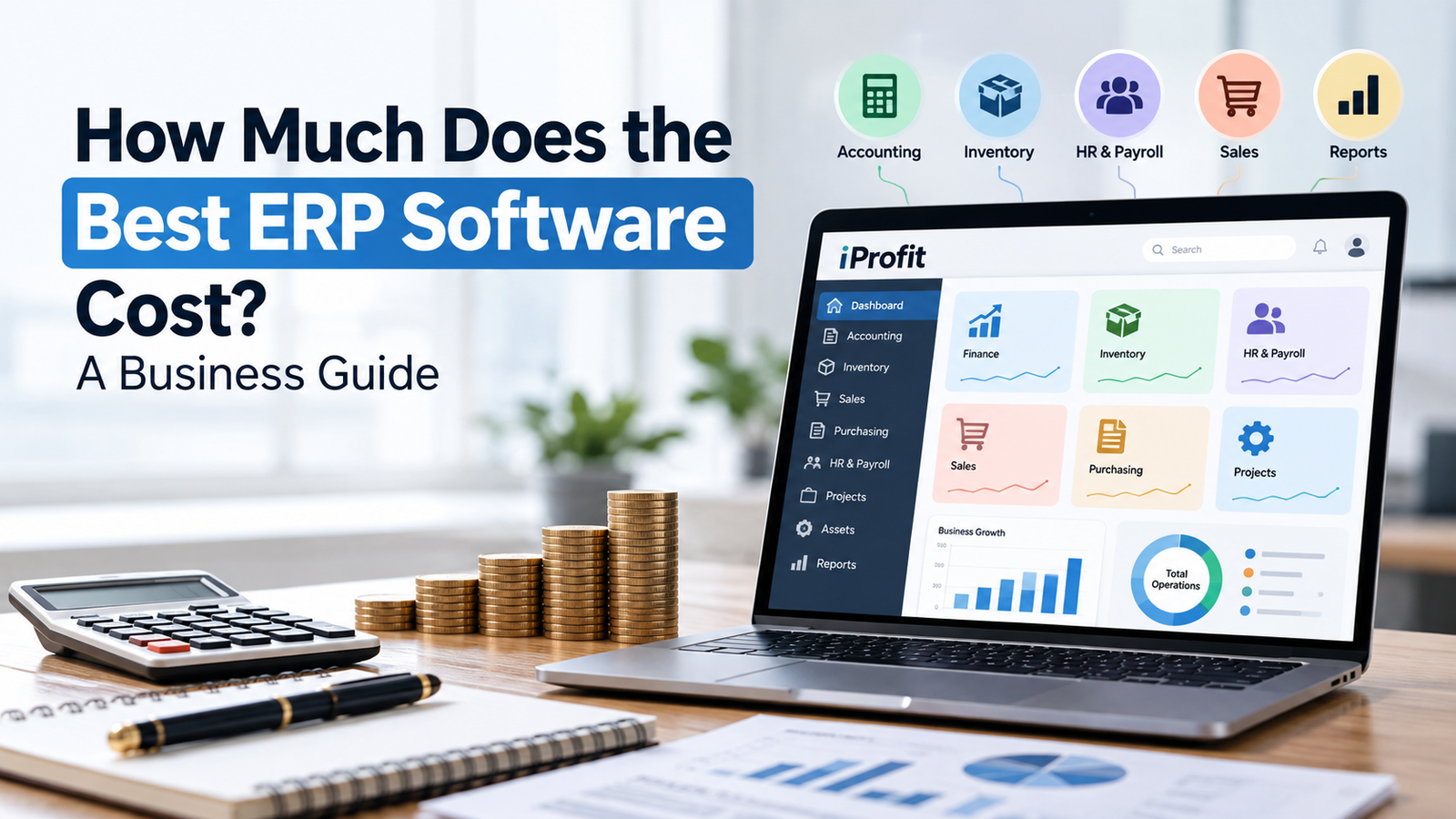


Choosing an Enterprise Resource Planning (ERP) system is an important decision for any business. ERP software brings different business functions such as accounting, inventory, sales, purchasing, human resources, and reporting into one connected platform. However, one of the first questions businesses ask before investing in an ERP system is: How much does the best ERP software cost?
There is no single price that applies to every business. ERP software pricing depends on several factors, including the number of users, features required, deployment method, business size, level of customisation, implementation requirements, and ongoing support. Understanding these factors can help businesses create a realistic budget and select an ERP solution that provides long-term value.
For businesses considering an ERP investment, iProfit offers an integrated approach to managing important business operations through a unified software environment. Before choosing any ERP system, it is useful to understand what contributes to the overall cost and what businesses should consider beyond the initial price.
What Determines the Cost of ERP Software?
The cost of ERP software is influenced by more than just the software licence or subscription. Businesses should consider the complete cost of ownership when comparing different solutions.
The first factor is the number of users. Many ERP providers structure their pricing according to the number of employees or users who need access to the system. A small company with a limited number of users may have lower software costs than a large organisation with multiple departments and locations.
The second factor is functionality. A business may only need accounting and invoicing features, while another organisation may require accounting, inventory management, payroll, HR, sales, purchasing, asset management, and project management. More modules and advanced functionality can increase the overall cost.
Customisation is another important consideration. Some businesses can work with standard ERP features, while others need customised workflows, reports, integrations, or dashboards. Customisation can increase the initial implementation cost, but it may be useful when a company has specific operational requirements.
Common ERP Pricing Models
ERP providers generally use different pricing models. Understanding these models can make it easier to compare solutions.
Subscription-Based ERP
Cloud-based ERP systems commonly use a subscription model. Businesses pay a recurring monthly or annual fee based on users, modules, or other usage factors.
This model can make ERP software easier to adopt because businesses do not necessarily need a large upfront investment in infrastructure. The subscription may also include software updates, hosting, security, and technical support, depending on the provider and plan.
Per-User Pricing
Some ERP systems charge according to the number of users. For example, a company with ten employees accessing the ERP may pay less than a company with fifty users.
However, businesses should check how the provider defines a user. Some systems distinguish between full-access users, limited users, employee users, or occasional users. Understanding these details can prevent unexpected costs as the organisation grows.
Module-Based Pricing
Another approach is to pay for the ERP modules the business needs. A company may start with accounting and inventory management and later add HR, payroll, sales, purchasing, or other modules.
This approach can provide flexibility, especially for growing businesses that do not need every ERP feature from the beginning.
Custom or Enterprise Pricing
Larger organisations may require customised ERP packages. Pricing can depend on the number of departments, locations, users, integrations, workflows, and implementation requirements.
For this type of ERP deployment, providers often offer customised quotations instead of publishing a fixed price.
What Additional Costs Should Businesses Consider?
When calculating the cost of the best ERP software, businesses should look beyond the advertised subscription or licence price.
Implementation is one important cost. Implementing an ERP system may involve configuring the software, setting up users, defining workflows, importing data, and connecting the system with existing business applications.
Data migration can also require additional work. Businesses may have financial records, customer information, supplier details, inventory data, employee information, and other records stored across different systems. Moving this information into a new ERP platform needs proper planning and validation.
Training is another consideration. Employees need to understand how to use the new system correctly. Training may be provided through documentation, online sessions, demonstrations, or dedicated onboarding programs.
Businesses should also consider integrations. An ERP may need to connect with payment systems, e-commerce platforms, CRM tools, banking systems, payroll applications, or other software. Depending on the integration requirements, additional development or configuration costs may apply.
Finally, companies should understand ongoing support and maintenance costs before making a decision.
Is Expensive ERP Software Always Better?
A higher ERP price does not automatically mean that the software is better for every business. The right ERP system depends on the organisation’s requirements.
For example, a small business may not need a highly complex enterprise system with hundreds of features. Paying for functionality that employees rarely use may increase costs without providing proportional value.
At the same time, choosing an extremely low-cost system without considering scalability, security, reporting, support, or integration capabilities can create problems later.
The goal should be to find an ERP system that matches the company’s current requirements while providing enough flexibility for future growth.
How Business Size Affects ERP Costs
Small businesses typically have fewer users and simpler operational requirements. They may need core features such as accounting, invoicing, inventory, purchasing, and reporting.
Medium-sized businesses often require more advanced functionality. They may have multiple departments, larger inventories, more employees, and more complex approval processes.
Large businesses may need multi-location management, advanced reporting, extensive integrations, role-based access, custom workflows, and other enterprise-level capabilities.
Therefore, the best ERP software for one organisation may not be the right choice for another. ERP selection should be based on business processes rather than company size alone.
Cloud ERP vs On-Premise ERP Cost
Deployment method can also affect ERP costs.
With cloud ERP, the software is hosted on remote servers and accessed through the internet. Businesses generally pay a subscription or recurring fee. Depending on the provider, hosting, updates, security, and maintenance may be included.
On-premise ERP software is installed on the company’s own infrastructure. This can require investment in servers, networking, IT resources, backups, security, and maintenance.
Cloud ERP can therefore offer a different cost structure from traditional on-premise systems. Businesses should compare the total cost over several years rather than looking only at the initial investment.
How to Calculate the Total Cost of ERP Software
A simple way to estimate ERP expenditure is to consider all major cost categories together.
The calculation can include:
Total ERP Cost = Software Fees + Implementation + Data Migration + Training + Integrations + Customisation + Support and Maintenance
Not every business will have expenses in every category. However, considering these areas can provide a more realistic picture of the investment.
Businesses should also calculate potential benefits. These may include reduced manual work, better visibility into operations, improved reporting, fewer duplicate processes, better inventory control, and more efficient financial management.
What Should You Check Before Choosing ERP Software?
Before selecting an ERP platform, businesses should create a list of their most important requirements.
Start by identifying the departments that will use the system. Then list the processes that need to be automated or centralised. Consider accounting, finance, inventory, sales, purchasing, HR, payroll, projects, assets, and reporting.
Next, determine the number of users and identify different user roles. This can help when comparing pricing plans.
Businesses should also evaluate the software’s scalability. The system should be able to support additional users, products, transactions, departments, or locations as the company grows.
Security should also be considered. Ask about access controls, data protection, backups, authentication, and other security measures offered by the ERP provider.
Finally, evaluate customer support, implementation assistance, training, updates, integrations, and reporting capabilities.
Why iProfit Can Be Considered for Business Management
iProfit is designed to help businesses manage multiple operational functions through an integrated software environment. Instead of relying on separate systems for different departments, an integrated ERP approach can help bring important business information together.
Businesses can evaluate iProfit based on their specific requirements, including accounting, inventory, HR, payroll, sales, asset management, project management, and other operational processes.
The most important consideration is whether the available features, pricing structure, scalability, support, and implementation approach align with the company’s needs.
Final Thoughts
The cost of the best ERP software depends on many factors, including users, features, modules, deployment method, customisation, implementation, integrations, training, and support. Because of these variables, businesses should avoid choosing an ERP system based solely on its advertised starting price.
A better approach is to calculate the total cost of ownership and compare it with the operational value the software can provide. Businesses should identify their requirements, understand pricing structures, evaluate scalability, and check additional costs before making a final decision.
For businesses evaluating ERP solutions, iProfit can be considered as part of the selection process. The right ERP investment should help bring business functions together, improve operational visibility, reduce manual processes, and provide a foundation that can support future growth.