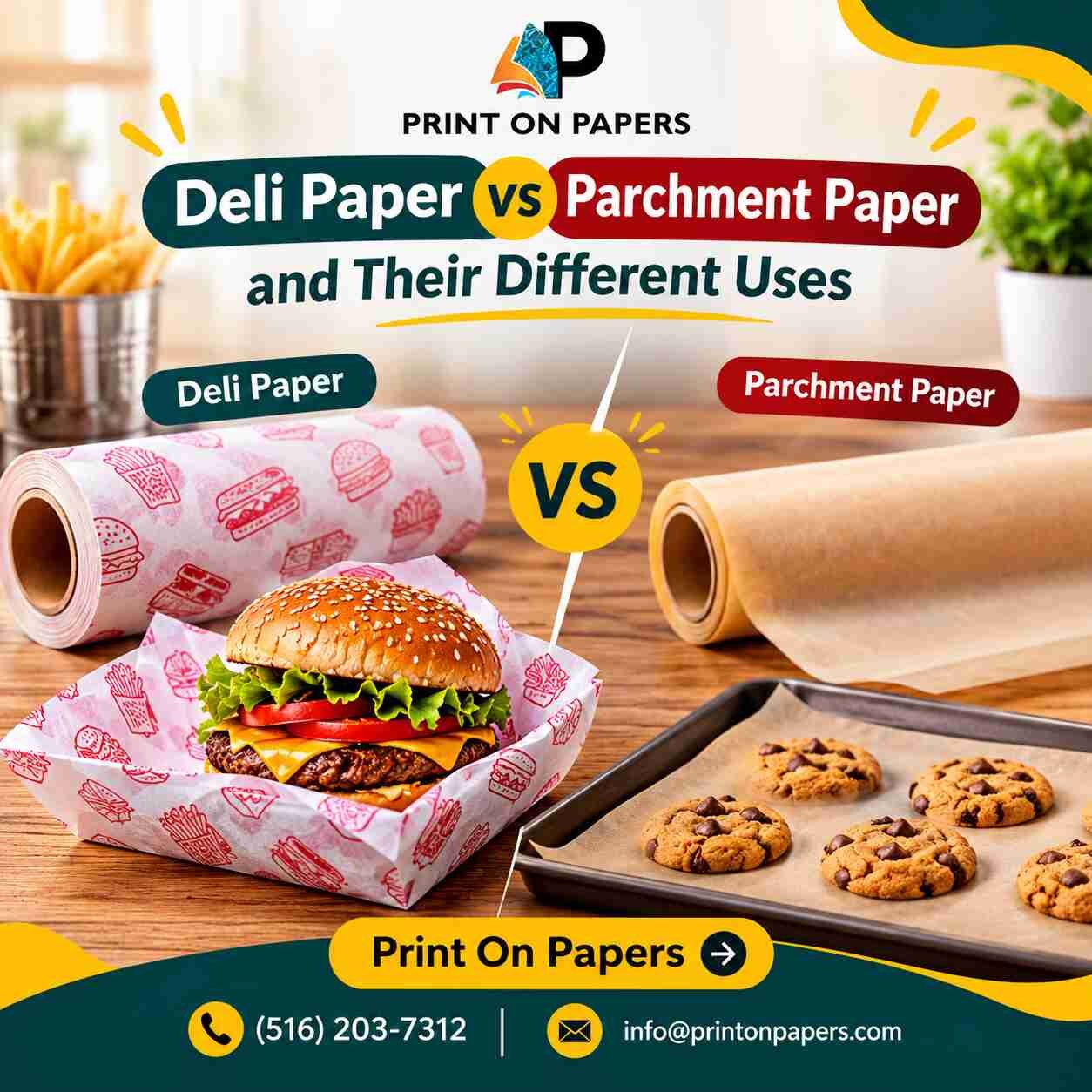


Deli paper is made for wrapping and serving food like sandwiches, burgers, and cold cuts, while parchment paper is made for baking and handles oven heat. Using the right one saves you from soggy wraps, stuck pastries, and wasted sheets. This guide compares the two side by side so you can match each paper to the job. You can see Print On Papers’ Custom Deli Paper page as you read.
What Is Deli Paper?
Deli paper is a thin, grease-resistant paper used to wrap and hold food that gets handed to a customer. It sits at the sandwich counter, the deli case, and the takeaway window.
Print On Papers makes custom deli paper from bleached or unbleached wood pulp in three weight grades. It comes in flat pre-cut sheets or custom rolls, with wax, PE, or uncoated finishes, and it can be printed with your logo.
It works well for:
- Sandwiches, wraps, and subs
- Burgers and other handheld food
- Deli meats and cheeses
- Lining trays and baskets
What Is Parchment Paper?
Parchment paper is a heat-resistant, non-stick paper made for baking and cooking. It’s usually coated so food releases cleanly and oils don’t soak through. Bakers use it to line sheet pans, wrap dough, and separate layers of pastries.
Print On Papers lists custom parchment paper in its range for baking and confectionery, rated up to about 450°F, in 40–60 GSM.
How Do They Compare?
The biggest difference is heat. Parchment is built for ovens, and deli paper is built for wrapping and serving.
| Deli paper | Parchment paper | |
|---|---|---|
| Main job | Wrapping and serving food | Baking and lining |
| Oven use | Not designed for baking | Yes, up to about 450°F |
| Non-stick surface | Limited | Strong |
| Grease resistance | Good, depending on weight and coating | Good |
| Typical weight (GSM) | 30–60 | 40–60 |
| Best for | Sandwiches, burgers, deli counters, takeaway | Cookies, pastries, bread, sheet pans |
| Custom printing | Yes | Yes |
Is Deli Paper the Same as Wax Paper?
No. Deli paper may have a wax coating, a PE coating, or no coating at all, depending on what you order. Wax-coated versions add a moisture barrier, while uncoated versions rely on the paper’s own grease resistance.
When Should You Use Deli Paper?
Use deli paper when food is going to a customer or a counter, not into an oven. It keeps grease and moisture off hands and bags, and it carries your brand where people see it.
The product page lists three weight grades:
| GSM | Best for |
|---|---|
| 30–40 | Tray lining and light wraps |
| 40–50 | Sandwiches and standard wrapping |
| 50–60 | Burgers and heavy, oily foods |
Standard deli paper is also microwave safe, which helps takeaway and delivery orders that get reheated. Wax-coated versions are the exception, so ask before you choose one for reheating.
When Should You Use Parchment Paper?
Use parchment paper when heat is involved. Lining a cookie sheet, wrapping fish for the oven, or separating layers of baked goods all call for parchment. Its non-stick surface lets sticky dough and sugar release without tearing.
Bakeries and confectionery brands also order printed parchment as a branded liner for boxes and trays, because the sheet holds up to warm pastries.
Can You Swap One for the Other?
Sometimes, but not in the oven. Parchment can wrap a sandwich in a pinch, but it costs more than you need for a cold wrap. Deli paper should never go into an oven, since coatings and fibers aren’t built for baking heat.
A simple rule: if it will be heated in an oven, use parchment. If it’s wrapping food for service or takeaway, use deli paper.
Can You Print on Both?
Yes. Print On Papers prints custom logos and patterns on both, using food-safe soy-based and water-based inks. Printing options include full-color CMYK and Pantone matching for exact brand colors. Flexographic printing suits large runs, and digital printing suits short runs and fine detail.
Are Both Food Safe?
They should be, and you should ask for the paperwork. Print On Papers states that its food papers are FDA-compliant under 21 CFR for direct food contact, use FSC-certified materials, and avoid PFAS in food-contact coatings. A growing number of US states restrict PFAS in food packaging, so confirming this now helps you avoid switching later.
How Do You Choose Between Them?
Ask yourself four quick questions:
- Will it go in an oven? If yes, choose parchment.
- Is it for wrapping or serving? If yes, choose deli paper.
- How oily is the food? Heavier GSM for burgers and fried items.
- Do you want branding on it? Both can be printed with your logo.
A cafe that bakes its own pastries and sells sandwiches often needs both: parchment in the kitchen and deli paper at the counter.
How Does Ordering Work and How Long Does It Take?
Ordering takes three steps: share your paper type, size, and quantity, approve a digital proof, then production and shipping. The product page lists about 6–7 business days for production and 4–5 business days for shipping. Shipping is free, and the quote form offers Standard (10–15 days) and Express (6–8 days) options.
Free design support is available if you only have a basic logo file, and a physical sample is available on request. The U.S. Small Business Administration notes that supplier lead times are a common pressure point for small businesses, so order before you run low.
What Does It Cost?
Price depends on paper type, weight, coating, sheet size, number of print colors (1, 2, or 4), and quantity. Larger orders lower the cost per sheet. Ask for a full quote with every cost listed, and confirm the minimum quantity when you request it.
Frequently Asked Questions
What is the difference between deli paper and parchment paper?
Deli paper is for wrapping and serving food like sandwiches and burgers. Parchment paper is for baking and handles oven heat with a non-stick surface.
Can deli paper go in the oven?
No, deli paper isn’t designed for baking heat. Use parchment paper for anything that goes in the oven.
How much does custom deli paper cost?
The price depends on weight, coating, size, colors, and quantity. Bigger orders lower the cost per sheet, so ask for a quote at a few quantities.
How do I order custom deli paper?
Fill out the quote form with your paper type, size, quantity, and logo. You’ll get a digital proof to approve before printing starts.
What is the minimum order quantity?
Small shops and large restaurant groups can both order. Confirm the exact minimum for your paper and size when you request a quote.
Is deli paper microwave safe?
Standard deli paper handles microwave reheating, but wax-coated versions may not. Ask which coating suits your takeaway and delivery orders.
Conclusion
Deli paper and parchment paper look similar, but they do different jobs. Deli paper wraps and serves, while parchment bakes and lines. Match the paper to the task, choose a weight that fits your food, and print your logo on whichever one your customers see. Check your proof before printing and order before you run low.