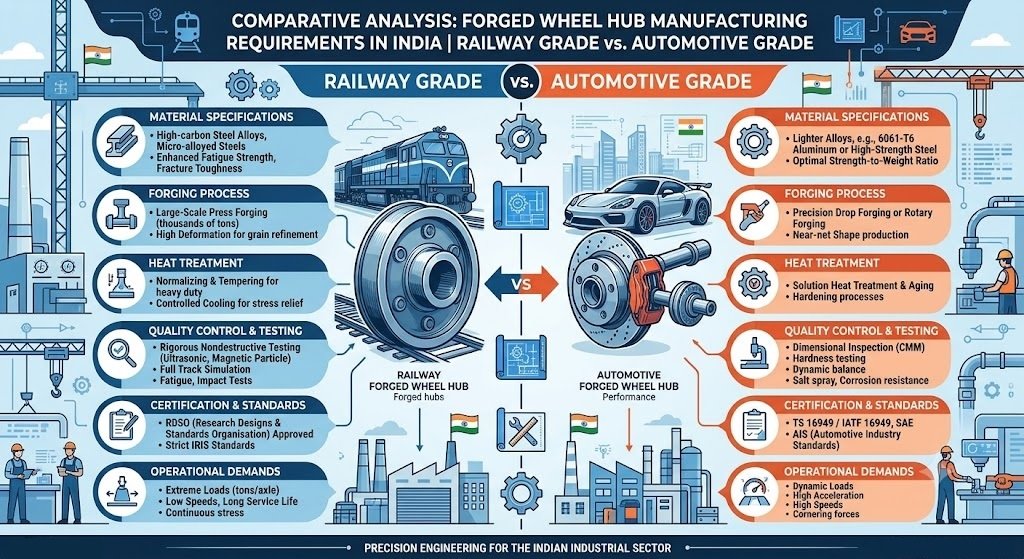


Wheel hubs fulfill a similar fundamental purpose in both railway vehicles and road-going automobiles by serving as a means of supporting rotating assemblies and transmitting loads between the wheel and the associated mechanical system. The differences in their application areas, however, impose significantly diverse requirements on the engineering solution. Railway components are exposed to high axle loads and long service cycles, whereas automotive hubs have to withstand vehicle weight, braking torques, cornering forces, vibration and varying road conditions within relatively limited dimensions and cost constraints.
The aforementioned factors affect the choice of materials, forging technology, heat treatments, tolerances and inspection methods. For forged wheel hub manufacturers India, the understanding of the difference between railway-grade and automotive-grade requirements is of particular importance while engineering components for two different transportation industries.
-
Requirements for Load Bearing Capacity
Wheel hubs (or components related to them) in a railway setting have to accommodate significantly high pressure or torque produced by the axle load. Depending on the application, these components also have to resist impact load (if applicable), and repeated stress caused by the long service cycle for railway transportation.
In a similar manner, automotive wheel hubs (the rotating part of an automotive wheel assembly) have to accommodate a range of rotating and impact load depending upon the vehicle type, speed, road surface, and other factors.
So, unless explicitly specified components designed or manufactured for one application cannot be employed for another due to substantially varying stress and fatigue criteria.
-
Quality of Materials
A range of materials can be selected for forging components for railway and automotive applications. The choice is made based on the requirement, including the desired level of static or dynamic loading.
Railway components may be manufactured using special steels where chemical composition, grain, and other microscopic characteristics need to conform to certain expectations to ensure quality and reliability. Additionally, components may be machined to size following certain standards. Finally, for any given component, the level of tensile strength, impact resistance, and other properties will have to be confirmed with the material testing laboratory.
Automotive wheel hubs may be manufactured using a range of materials such as aluminium (low-carbon steel). Each of the options has certain pros and cons in terms of load bearing capacity, weight, and other characteristics affecting performance.
For forged wheel hub manufacturers India, the overall chemical composition of the material alone is not sufficient to establish its reliability. Its microscopic properties, inclusions, grain structure, hardness, and similar attributes also become important. As in any other material selection, metallurgical tests (material certificate, inspection, etc.) are also carried out to confirm suitability.
-
The Manufacturing Process and Heat Treatment
A forging process is used to give the workpiece a specified shape, and the process determines mechanical properties and grain orientation of the material. However, the choice of the heat treatment method is not necessarily connected to the process. Instead, any given forged component has to go through processes allowing it to resist the expected service loads.
Components for railway and automotive applications have to meet specified requirements. For railway components, the choice of the heat treatment (temperature, time, and other parameters) will be based on the specified yield, impact level, ultimate tensile strength (UTS), and similar factors to ensure long service life.
Automotive components, too, have to be subjected to thermal and mechanical stress corresponding to their respective service loads. However, additional emphasis may be put on the quality of manufacturing (process consistency, process control, and similar characteristics). In a typical automotive manufacturing environment, component variability has to be minimised to ensure that interchangeability and high quality of the components is ensured across the production line.
-
Size Accuracy and Interface Characteristics
Wheel hubs for both railway and automotive applications have to match their respective mating components with required accuracy to ensure their proper operation.
In railway applications, requirements concern primarily the mating features (seating, bearing dimensions, and so on). These have to be measured (using the specified tools) to ensure that they correspond to the drawing and other specifications.
In an automotive setting, similar elements (bearings, mating parts, and others) also have to be considered. Failure to ensure accurate interface alignment will cause high stresses, causing the bearings to seize or fail prematurely.
Manufacturers carry out dimensional inspection using coordinate machines, precision measuring tools, and similar gadgets applying appropriate fixtures. As with any other aspect of manufacturing, measurement and verification activities have to ensure that the components are inspected and measured frequently enough for the given production volume and rate, and which elements have to be controlled.
-
Testing, Inspection, and Acceptance Requirements
Testing requirements for railway and automotive components depend first and foremost on their type and purpose. Typically, the choice of the test method has to be made conforming to the available standards and specifications. Testing may include a variety of elements ranging from material verification to the tests corresponding to the component’s application. In both scenarios, appropriate non-destructive and destructive testing methods employing ultrasonic, magnetic, or liquid inspection tools will have to be chosen based on the material, geometry, and types of defects that could be introduced into the workpiece. All testing and inspection equipment have to be calibrated and operated per specified requirements, and test results should be analysed to ensure that the quality of the forged component will match the design expectations. Acceptance and rejection criteria have to conform to the appropriate standard or, if applicable, the buyer’s specifications. In any given scenario, a test procedure will only be acceptable if it conforms to the needs of the component. If the appropriate test is available, it is possible to conduct it; otherwise, it is not.
Once the test is done, each result has to be reviewed against the specified criteria. Without proper traceability, an identified defect or problem would not correspond to the actual production item. An appropriate test report should, therefore, be available ensuring that the right part (with material batch identification) was tested per specified procedures. As in any other scenario, proper documentation (test records, material certification, etc.) has to be maintained.
-
Certification and Documentation Requirements
Railway components are often subject to special certification and documentation requirements depending on the component type and buyer. Specific requirements range from the need to comply with certain standards to the need to conform to certain documentation and testing specifications. In addition, a particular supplier will have to comply with certain requirements specified per the customer. Ascertaining general compliance with international standards is, therefore, not sufficient to indicate that all requirements are being followed for a given component.
Automotive components, as in any other component, have to meet documentation and certification requirements. General standards concerning quality control are typically applied in manufacturing operations, with production parts having to be approved according to certain procedures. Additionally, automotive specifications will apply concerning the compliance to relevant quality standards and related production requirements.
As the application and requirements differ, documentation for a railway and an automotive forging component will be different. For forged wheel hub manufacturers India, ensuring compliance with all requirements is essential to avoiding rejections and penalties. The level of sophistication of documentation requirements will have to be selected keeping in mind the requirements of the component. For example, documentation of a low-volume and high-precision automotive component will vary considerably from documentation corresponding to a simple railway component.
-
Volume, Price, and Other General Requirements
Forged wheel hubs (or other types of components) in the automotive industry are subject to a high production volume with requirements concerning reducing costs and waste, and maintaining process stability. Ensuring these aspects is essential to ensuring that a manufacturer is suitable for an automotive application.
In a similar manner, components for railway applications may have to be produced using a certain type of forging, and certain standards may have to be applied. The volume of the production for a given application will, however, affect such considerations. While some railway components may be produced in high volumes, others may be represented by a low-rate manufacturing process.
In any scenario, understanding the specific requirements of the client is essential to meeting general manufacturing and quality assurance expectations. If a forging manufacturer is considering becoming a supplier of the component parts, it must fully understand the production needs and capabilities, as well as the technical aspects of the intended component. So, while documentation for a given manufacturer is important, its abilities in regards to the production of the component will be important as well.
The Role of Shailesh Forging Works
When considering forged components for purchase, buyers should cross-reference a manufacturer’s capabilities against the drawings, material specifications and testing requirements of their proposed application. Shailesh Forging Works acts as an informative reference point for purchasers researching forging products and production capabilities. Suitability for railway or automotive applications should be supported by relevant technical documentation, customer approval and application-specific inspection reports.
Conclusion
While railway and automotive applications both involve forged components, the two industries have significantly different requirements in terms of loading conditions, materials, dimensioning, validation and supporting documentation. Railway applications might involve specialised compliance and longer service life requirements, while automotive applications may involve higher production volumes and more stringent process controls.
For forged wheel hub manufacturers India, the key takeaway is that these two applications should not be considered as interchangeable, and that manufacturers should understand the differences between the two. Traceability of materials, controlled forging process, appropriate heat treatment and application-specific testing should be implemented to ensure the suitability of a forged component. The correct forging process and inspection is what is needed for each component to meet the design and application requirements.